





Email marketing is still one of the highest-ROI channels in eCommerce — but only when it’s treated as a system, not a blast tool.
For WooCommerce brands, email should not exist in isolation. It should be tightly connected to customer behavior, consented data, paid media, and analytics. When that happens, email stops being “just another channel” and becomes a growth engine for LTV, profitability, and retention.
In this article, I’ll break down how eCommerce brands using WooCommerce can build a modern, data-driven email marketing strategy that improves customer experience and business results.
Email marketing is not about sending more emails — it’s about sending the right ones
One of the biggest mistakes I see in WooCommerce stores is treating email as a volume game:
more campaigns, more discounts, more noise. Effective email marketing is about:
- Relevance
- Timing
- Intent
- Context
Every email should exist for a reason — and that reason should be tied to customer behavior and lifecycle stage, not just a promotional calendar. Without a clear strategy, brands end up reacting instead of building: sending emails “because it’s Friday” instead of because the data says this user is ready for this message.
Why email performs so well in eCommerce (when done right)
Email continues to outperform many channels because:
- You own the relationship (no algorithm dependency)
- Messages are permission-based
- It works across the entire customer lifecycle
But the real power of email comes from automation, not campaigns alone. Behavior-triggered flows (like abandoned cart or post-purchase emails) consistently generate:
- Higher revenue per recipient
- Higher conversion rates
- Better customer experience
Because they respond to real user intent in real time.
Step 1: Audit your WooCommerce data before writing a single email
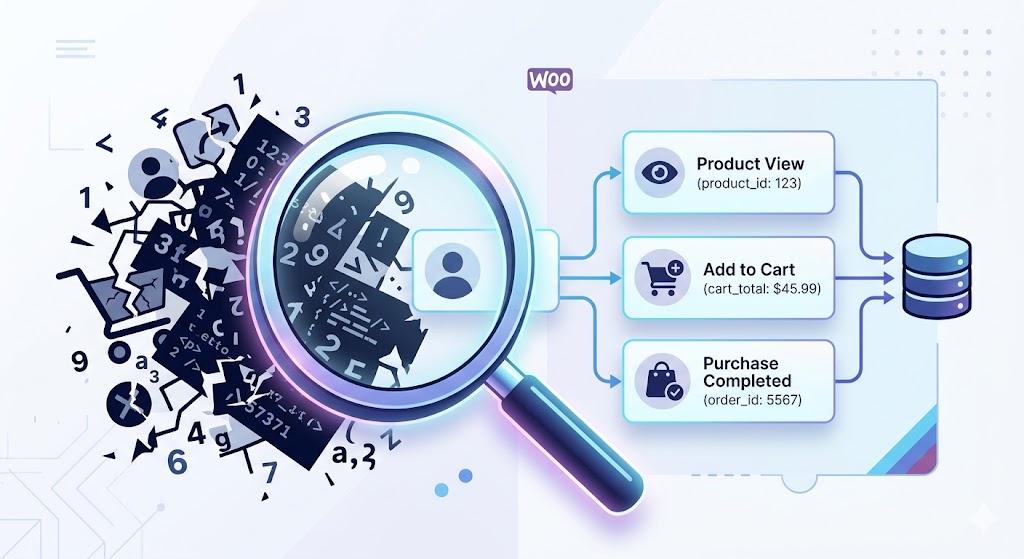
Before thinking about content, start with data. A proper email strategy begins with understanding:
- Who your customers are
- How they behave on your store
- Where friction and drop-off happen
For WooCommerce brands, this means auditing:
- Tracking setup (GA4, GTM, data layers)
- Events (product views, add to cart, checkout steps)
- Customer properties (purchase history, frequency, AOV)
- Consent and privacy signals
If your data is fragmented or unreliable, no amount of “good copy” will fix the results.
Step 2: Define email goals that align with business objectives
Email goals should support the overall growth strategy, not exist in a silo. Common WooCommerce email goals include:
- Growing a qualified subscriber list
- Increasing conversion rate
- Reducing cart abandonment
- Increasing repeat purchases
- Improving Customer Lifetime Value (LTV)
The key is choosing one primary goal at a time and ensuring you have enough data to measure impact properly. Good email strategies babidding:
- Long-term consistency
- Continuous testing and iteration
Step 3: Choose email and CRM tools that integrate deeply with WooCommerce
Basic ESPs are no longer enough. WooCommerce brands need tools that:
- Sync customer and order data in real time
- Support behavioral segmentation
- Enable advanced automations
- Integrate with analytics and paid media
Your email platform should help you:
- Unify fragmented data
- Turn it into actionable insights
- Personalize communication across the entire lifecycle
Without adding unnecessary complexity.
Step 4: Build your email list the right way
List growth only matters if the data is usable. In WooCommerce, email sign-ups should be connected to:
- Explicit consent
- Clear value exchange
- Data enrichment opportunities
Effective list growth methods include:
- Incentives (discounts, free shipping, early access)
- Embedded forms and pop-ups
- Checkout opt-ins
- Post-purchase subscriptions
The goal is not just more emails — it’s better signals.
Step 5: Segment based on behavior, not assumptions
If you’re sending the same email to everyone, you’re wasting money. WooCommerce gives you powerful segmentation opportunities, such as:
- Product views
- Categories browsed
- Purchase frequency
- Average order value
- Time since last purchase
Behavioral segmentation allows you to:
- Increase relevance
- Reduce unsubscribes
- Improve conversion rates
Personalization starts with asking: What does this customer actually need right now?
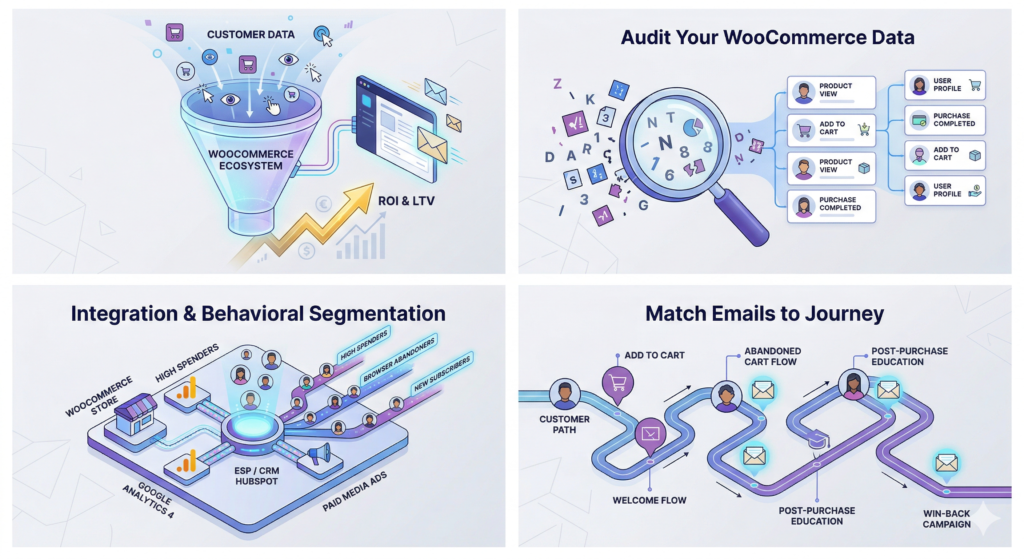
Step 6: Match emails to each stage of the customer journey
Different lifecycle stages require different messages.
Email campaigns
Campaigns work best when they are:
- Highly segmented
- Purpose-driven
- Aligned with user intent
They can be:
- Promotional
- Educational
- Retention-focused
Email automations (where the real value is)
For WooCommerce, essential automations include:
- Welcome flows
- Abandoned cart
- Browse abandonment
- Post-purchase education
- Cross-sell and replenishment
- Win-back flows
Automations outperform campaigns because they react to behavior, not schedules.
Step 7: Design emails for clarity, not decoration
Good email design supports the message — it doesn’t distract from it. Focus on:
- Clear hierarchy
- Strong CTAs
- Mobile-first layouts
- Consistent branding
Frequency also matters. Test different cadences and monitor:
- Engagement
- Spam complaints
- Unsubscribes
Data should dictate how often you send, not gut feeling.
Step 8: Test one variable at a time
A/B testing is essential — but only when done correctly. Test things like:
- Subject lines
- CTAs
- Layouts
- Messaging angles
Always test one element at a time so you know what actually caused the change in performance.
Step 9: Measure what matters (especially in a privacy-first world)
Open rates alone are no longer reliable. WooCommerce brands should focus on:
- Click-through rate
- Conversion rate
- Revenue per recipient
- Repeat purchase rate
- LTV impact
- ROI
Email performance should be evaluated in the context of the full funnel, not in isolation.
Final thoughts: Email is a growth system, not a channel
Email marketing has enormous potential for WooCommerce brands — but only when it’s built intentionally. When email is connected to:
- Clean data
- Proper tracking
- Consent management
- Paid media
- Analytics
…it becomes one of the most powerful levers for profitable and sustainable eCommerce growth. That’s where most brands leave value on the table.
Email marketing is not about sending more messages — it’s about building a system that connects customer behavior, data, and intent across the entire WooCommerce journey.
When email is treated as an integrated part of your eCommerce ecosystem — linked to tracking, consent, CRM, paid media, and analytics — it becomes far more than a communication channel. It becomes a predictable, scalable driver of revenue, retention, and customer lifetime value.
The most successful WooCommerce brands don’t rely on generic campaigns or gut feeling If you’re running WooCommerce and email still feels fragmented, manual, or underperforming, the problem is rarely the channel itself — it’s the lack of a connected, data-driven strategy.