






Many eCommerce leaders operate under the comforting illusion that a standard cookie banner on their primary storefront is enough to satisfy global regulators and maintain customer trust. But what if this fragmented approach to consent is actually acting as a silent ceiling on your revenue expansion? For high-growth brands managing multiple domains or subdomains, the hidden cost of inaction lies in the friction of repetitive consent requests, which destróis user experience and leads to massive data gaps that prevent you from accurately tracking behavioral signals and maximizing Customer Lifetime Value (LTV).
The hard reality is that in a landscape governed by GDPR and CCPA, a “one-size-fits-all” banner on a single domain cannot support the sophisticated, multi-site ecosystems required for modern scale. Transitioning to a robust cross-domain cookie consent strategy is not merely a legal checkbox; it is a strategic necessity that ensures a seamless, unified user journey while safeguarding the integrity of your analytics and marketing attribution. This guide explores the technical and legal pillars of cross-domain consent, providing the roadmap needed to eliminate technical debt and fuel automated growth across your entire digital footprint.
What is cross-domain cookie consent and how does it work?
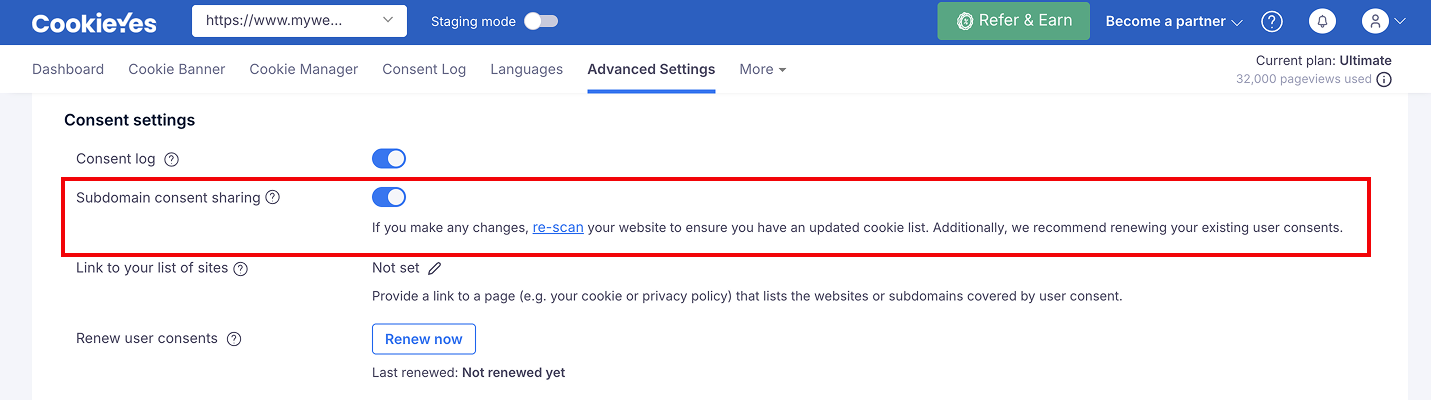
Cross-domain cookie consent is a technical and legal framework that allows a user’s privacy preferences to be synchronized across multiple independent domains or subdomains owned by the same organization. For high-growth brands operating a multi-site architecture—such as separate domains for regional stores, blogs, or loyalty portals—this mechanism ensures that once a visitor interacts with a consent banner on the primary site, their choice is automatically respected across all linked properties. This prevents “consent fatigue,” where repetitive banners disrupt the customer journey and negatively impact conversion rates.
The underlying mechanism typically relies on a centralized Consent Management Platform (CMP) or custom API integrations to bridge the gap created by browser-level privacy restrictions. While browsers naturally block the sharing of first-party cookies across different domains for security, cross-domain consent works through the following workflows:
- Data Centralization: A user’s unique consent ID and specific category preferences (e.g., analytics accepted, marketing rejected) are stored in a centralized database or a shared “master” domain.
- Preference Synchronization: When the user navigates to a secondary domain, a script or iframe retrieves the stored consent token via a secure HTTP request or cross-domain messaging API.
- Automated Application: The local site identifies the existing consent record and automatically applies the corresponding cookie blocking logic without re-triggering a pop-up, maintaining a seamless and compliant user experience.
Implementing this effectively requires strict uniformity in cookie categorization and legal disclosures across all participating domains. If the cookie types or data processing purposes differ between your WooCommerce store and its subdomains, the shared consent may be deemed invalid under GDPR or CCPA. Ensuring your technical stack supports millisecond-latency synchronization is critical to protecting your performance metrics and maintaining trust as you scale your digital ecosystem.
Why is cross-domain consent critical for WooCommerce growth?
For high-growth WooCommerce brands operating across multiple regional stores or brand-specific domains, maintaining a frictionless user journey is paramount for maximizing conversion rates. When a customer moves between your primary storefront, a dedicated loyalty portal, or a separate support domain, encountering repetitive cookie consent banners creates significant “consent fatigue.” This friction directly correlates with increased bounce rates and a degradation of brand trust, as users perceive the redundant requests as a failure of technical integration. By implementing cross-domain consent, you ensure a unified experience that respects user choices across your entire digital ecosystem without compromising on legal compliance.
- Optimized Conversion Funnels: Eliminating redundant banners prevents interruptions during critical transitions, such as moving from a content-driven subdomain to the WooCommerce checkout environment, thereby reducing cart abandonment.
- Data Continuity and Attribution: Cross-domain consent allows for accurate tracking of Customer Lifetime Value (LTV) and marketing attribution by maintaining a consistent user identifier across different properties, which is essential for data-driven scaling.
- Regulatory Risk Mitigation: Centralizing consent records across domains simplifies the technical burden of proof required by GDPR and CCPA, ensuring that a withdrawal of consent on one site is instantly honored across all brand assets to avoid heavy non-compliance penalties.
Strategic growth in the WooCommerce ecosystem requires more than just high-performance hosting; it demands a sophisticated approach to privacy that treats compliance as a competitive advantage. Transitioning from isolated consent silos to a synchronized cross-domain architecture allows your brand to capture higher-quality behavioral data while simultaneously improving the Customer Acquisition Cost (CAC) by removing unnecessary technical barriers. This professional infrastructure signals to both regulators and customers that your organization is committed to a data-first, privacy-conscious expansion strategy.
How to implement cross-domain cookie consent across multiple domains?
Implementing cross-domain cookie consent is a technical necessity for high-growth WooCommerce brands operating across multiple storefronts or regional domains. To ensure a frictionless user journey and maintain regulatory compliance, you must move beyond standalone banners and establish a unified consent architecture. This involves synchronizing the user’s privacy choices so that a preference set on your main shop is automatically recognized on your blog or secondary niche sites, preventing the “consent fatigue” that often drives up bounce rates.
- Domain Grouping: Utilize a Consent Management Platform (CMP) to aggregate all related domains into a single group. This allows the system to share a centralized consent record, ensuring that once a visitor interacts with the banner on one property, their preference is propagated across the entire network.
- Technical Synchronization: For subdomains, configure your cookies to be set at the root domain level (e.g., .example.com) to allow native browser access. For entirely separate top-level domains, implement a CMP that uses secure iframes or a centralized API to pass consent tokens, ensuring the data is transferred even as browsers increasingly restrict third-party cookies.
- User Identification: For the most resilient implementation, leverage unique user identifiers such as a hashed email or login ID. By linking consent to a specific user profile rather than just a browser session, you can maintain consistent compliance records across different devices and domain environments, which is critical for maximizing Customer Lifetime Value (LTV).
By standardizing your cookie categories and scripts across all properties, you create a cohesive legal foundation that satisfies both GDPR and CCPA requirements. A well-executed cross-domain strategy not only streamlines your backend operations but also builds significant brand trust by demonstrating a professional, privacy-first approach to customer data management.
What are the legal requirements for GDPR and CCPA cookie compliance?
Navigating the legal landscape of data privacy requires a clear understanding of the fundamental differences between European and American regulatory frameworks. For WooCommerce merchants, the GDPR establishes an “opt-in” mandate, where non-essential cookies—such as those used for marketing and advanced analytics—must be blocked by default until a user provides explicit, affirmative consent. Conversely, the CCPA primarily follows an “opt-out” model, allowing businesses to load scripts initially but requiring a clear and prominent “Do Not Sell or Share My Personal Information” link to facilitate a user’s right to halt data sharing.
- Prior Consent Blocking: Under GDPR, tracking scripts like Meta Pixels or Google Analytics tags must not execute until the visitor has actively interacted with the consent banner.
- Granular Choice: Users must be able to consent to specific categories of data processing, such as allowing functional cookies while rejecting advertising trackers, rather than being forced into a binary “accept all” choice.
- Transparency and Accessibility: Both frameworks require a detailed Privacy and Cookie Policy that explains what data is collected and why, and users must be able to withdraw or change their consent as easily as they initially provided it.
Failure to reconcile these requirements leads to more than just legal exposure; it creates technical debt that can degrade your site’s performance and destrói customer trust. Implementing a region-aware consent management system ensures that you meet the high bar of GDPR for EU visitors while simultaneously providing the required opt-out mechanisms for California consumers. For a high-growth store, this technical compliance is the bedrock of a sustainable data strategy, allowing you to build reliable marketing audiences without compromising user autonomy or facing significant regulatory penalties.
How to automate cookie consent sharing to improve user experience?
For WooCommerce merchants operating multiple storefronts or international subdomains, automating consent sharing is a technical requirement to eliminate friction. By implementing a unified synchronization layer, you ensure that a user’s choice on your primary domain is immediately respected on auxiliary sites, preventing redundant banner interruptions that trigger immediate bounce behavior.
- Root Domain Configuration: For subdomains, configure consent cookies at the parent level (e.g., .brand.com) to allow browser-level persistence across all related child domains automatically.
- CMP Synchronization Scripts: Utilize a Consent Management Platform (CMP) that triggers secure background synchronization calls or uses iframes to pass the unique consent string to related domains within your organizational network.
- Auth-Based Identity Mapping: For logged-in customers, map consent preferences to their unique User ID and pass this state via a secure JWT during the initial page load of an alternate domain to ensure preference persistence without re-prompting.
From a growth perspective, reducing “consent fatigue” is critical for maintaining high conversion momentum across a brand ecosystem. When a visitor experiences a seamless transition between a content site and the WooCommerce checkout without being re-prompted for tracking permissions, you preserve the user experience while securing accurate cross-site attribution. This automation ensures your analytics and marketing tags fire consistently, providing the clean data needed for scaling ROI.
Ready to take your e-commerce to the next level?
While understanding the technicalities of cross-domain cookie consent is a vital compliance step, the business reality for scaling WooCommerce brands is that fragmented tracking and broken user journeys are silent killers of profitability. If your attribution data feels like it is failing to tell a cohesive story, or if you suspect that repetitive consent barriers are inflating your bounce rates and eroding customer trust across your ecosystem, you are facing a structural barrier to growth. Managing consent isn’t just about avoiding legal risk; it is about maintaining a clean, high-fidelity data stream that allows you to capture revenue at every touchpoint of the customer journey without technical friction.
To move beyond basic compliance and build a high-performance eCommerce engine, you need a strategic partner that synchronizes your privacy-compliant data collection with your broader growth objectives. We act as an extension of your team, helping DTC brands maximize Profit, Retention, and LTV through data-driven systems where tracking, CRM, and paid media operate in perfect concert. Our process begins with rigorous, conversion-focused audits to eliminate guesswork and identify the exact bottlenecks in your tracking and consent architecture. If you are ready to transition from fragmented data to a scalable, privacy-first system that maximizes ROAS, book a free consultation today.