





Many businesses assume GDPR and CCPA are interchangeable, treating them as a monolithic compliance challenge that creates equal friction across all regions. This leads to a dangerously generic, one-size-fits-all approach to consent banners, which is the hidden cost of inaction. By failing to precisely differentiate between the two—and especially by ignoring the nuances of the coming CPRA—eCommerce businesses are operating with non-compliant, low-quality data pipelines. This flawed foundation silently sabotages your most valuable assets, resulting in a quantifiable loss of high-intent leads and a massive erosion of Customer Lifetime Value (LTV) across your Email and SMS marketing channels.
The critical reality for global eCommerce growth is that legal compliance is not a revenue ceiling; it’s the required blueprint for revenue expansion. The savviest brands treat the differences between the EU’s GDPR, California’s CCPA, and the upcoming CPRA as a strategic guide for localization, trust, and conversion rate optimization. They understand that a consumer’s “right to reject” in one jurisdiction may be fundamentally different from their “right to opt-out of sale” in another. This guide cuts through the confusion to provide the key legal and strategic differences between GDPR, CCPA, and CPRA, allowing you to build a privacy framework that automates trust and dramatically improves your bottom line.
Scaling Email & SMS Lists: How GDPR’s Opt-In Model Compares to CCPA/CPRA
The primary distinction between GDPR and CCPA/CPRA profoundly impacts email and SMS list scaling for WooCommerce merchants. GDPR operates on an opt-in principle, requiring explicit, freely-given, specific, informed, and unambiguous consent before any personal data processing for marketing can occur. This translates to a Permission-First approach where pre-checked boxes are illegal. Conversely, CCPA/CPRA operates more on an opt-out model regarding data sharing, granting consumers the ‘Right to Opt-Out of Sale/Sharing’ via a conspicuous link. For list building, the GDPR standard, while yielding lower initial volume, produces substantially higher-quality, high-intent leads with a demonstrably greater Customer Lifetime Value (LTV).
For a global WooCommerce operation, the most strategic and risk-averse approach is to harmonize your data capture practices toward the higher standard of GDPR’s explicit consent. While CCPA/CPRA technically allows for less stringent initial opt-in for direct marketing, prioritizing transparency and user choice globally minimizes multi-jurisdictional compliance risk and builds foundational customer trust. To scale your Klaviyo and SMS lists both effectively and compliantly, focus on the following key operational shifts:
- Global Opt-In Default: Use clear, unchecked consent boxes for all email/SMS sign-ups, regardless of a user’s location. Avoid relying on implied consent for direct marketing channels.
- Geo-Targeted Compliance: Deploy a Consent Management Platform (CMP) that automatically presents the GDPR-level explicit banner to EU/UK visitors, while ensuring that California-based users have a prominent ‘Do Not Sell or Share My Personal Information’ link visible per CCPA/CPRA rules.
- Double Opt-In Implementation: Adopt a double opt-in process for all new subscribers. This is a critical GDPR best practice and an immediate data hygiene safeguard, ensuring high list deliverability and segment quality that drives profitable campaigns.
Adopting a GDPR-grade, explicit consent approach for all list sign-ups transforms data collection from a potential legal risk into a high-value asset. The initial trade-off of lower raw subscriber numbers is typically offset by a significant increase in subscriber engagement, reduced churn, and a cleaner, more legally defensible customer database, fueling more profitable, targeted campaigns and sustainable WooCommerce revenue growth.

Automating Multi-Jurisdictional Compliance: A Blueprint for WooCommerce Revenue Growth
The shift from regional to global eCommerce mandates that a WooCommerce store’s consent strategy evolves beyond a basic, static banner. A ‘one-size-fits-all’ consent modal—which often defaults to the most stringent rule like GDPR’s opt-in—can unnecessarily stifle revenue in less restrictive jurisdictions like the US. Multi-jurisdictional compliance is not merely about avoiding fines; it’s a revenue blueprint centered on maximizing legally acquired data. Automation through a robust Consent Management Platform (CMP) is the only viable path to simultaneously satisfy the GDPR’s active consent requirement and the CCPA/CPRA’s ‘Do Not Sell or Share’ opt-out mandate, ensuring the user experience remains frictionless and conversion-friendly regardless of geography.
- Geo-IP Mapping and Targeting: Implement a CMP with precise Geo-IP filtering to automatically detect a user’s location and serve the corresponding legal framework. Users from the EU/UK must receive a diretrizry opt-in banner with equal ‘Accept’ and ‘Reject’ buttons, while users from California must be presented with the ‘Do Not Sell or Share My Personal Information’ link.
- Dynamic Cookie Scanning: Ensure your CMP automatically scans and categorizes cookies from all WooCommerce plugins and third-party scripts after a legal change (like CPRA’s recent amendments). This prevents accidental non-compliance where new marketing pixels are deployed without being governed by the regional consent mechanism.
- Consent Data Synchronization: The CMP must integrate with your WooCommerce backend and CRM/marketing automation tools. The explicit legal basis for data processing (Opt-in vs. Legitimate Interest) should be passed as a customer property, enabling legally compliant segmentation and personalized marketing efforts for each jurisdiction.
This automated, multi-jurisdictional approach transforms a legal cost center into a scalable growth engine. By dynamically adjusting the friction point (the consent banner) based on the user’s law, you dramatically reduce unnecessary cart abandonment and protect your store from costly regulatory non-compliance. The resulting data pipeline is composed exclusively of high-quality, explicitly-consented customer information, which yields substantially higher Customer Lifetime Value (LTV) for your entire global audience.
The True Cost of Non-Compliance: Comparing GDPR and CCPA/CPRA Financial Penalties
The difference in statutory penalties between the GDPR and the CCPA/CPRA is not merely a matter of scale; it reflects a fundamental jurisdictional difference in enforcement philosophy. GDPR’s penalties—reaching up to €20 million or 4% of annual global turnover—are designed to target global, systemic failure, posing an existential threat to large enterprises. The CCPA, amended by the CPRA, imposes fines up to $7,500 per intentional violation and $2,500 for unintentional ones, with the unique element of a private right of action for security breaches. For a WooCommerce operation, this means the risk shifts from a massive, singular global fine (GDPR) to a compounding risk of statutory damages multiplied by thousands of affected Californian consumers (CCPA/CPRA).
However, focusing solely on the statutory maximums ignores the non-regulatory, compounding financial damage that non-compliance inflicts on an eCommerce business. These costs often surpass the initial fine and directly impact the long-term viability and valuation of the company:
- Data Quality Contamination: Violations often stem from improper consent collection (e.g., using dark patterns), resulting in data that is legally and ethically compromised. This unusable data pollutes marketing segmentation, leading to wasted ad spend and inaccurate revenue forecasting, fundamentally undermining your growth engine.
- Reputational and Trust Erosion: Public enforcement action or a consumer-facing data breach destroys the trust signal that drives repeat purchases. The resulting spike in customer churn and increased Customer Acquisition Cost (CAC) represents a continuous revenue bleed that far outlasts any single fine.
- Private Litigation Risk (CCPA/CPRA): The private right of action in the CCPA/CPRA for certain security breaches exposes the business to class-action lawsuits. The defense and settlement costs of this litigation are often unpredictable and can easily eclipse the regulatory fine itself, requiring dedicated legal reserve and ongoing audit expense.
For a multi-jurisdictional WooCommerce store, the true cost is the inability to build scalable Customer Lifetime Value (LTV) on a foundation of clean, legally obtained data. Proactive investment in a robust, globally compliant Consent Management Platform (CMP) is not an expense for legal defense, but a shield that protects both your babidding sheet from regulatory exposure and your future revenue from structural data and trust failures.
Data Quality and LTV: Why CCPA/CPRA’s ‘Do Not Sell’ is a Trust Signal for eCommerce
The ‘Do Not Sell or Share My Personal Information’ (DNS) link required by CCPA/CPRA is fundamentally a moment of self-qualification for your WooCommerce customer base. Instead of viewing the resulting opt-out as lost data, it should be recognized as a proactive filter for data quality. When a customer utilizes the DNS feature, they are signaling a higher degree of data awareness. Respecting this decision is a powerful, immediate trust signal that converts legal friction into brand integrity, directly underpinning long-term Customer Lifetime Value (LTV).
Operationalizing the DNS request is how a WooCommerce store transforms compliance into a competitive advantage. The value of this signal lies not in what data you lose, but in the certainty of the data you retain. By segmenting customers based on their CCPA/CPRA choices, you can refine your marketing and ad spend to focus exclusively on highly qualified, consenting audiences. This is a critical pivot away from the high-volume, low-integrity data model that often leads to wasteful retargeting campaigns and compliance risk.
Here is a blueprint for leveraging the CCPA/CPRA DNS signal for maximum LTV impact:
- High-Fidelity Segmentation: Immediately tag the user in your CRM and analytics platform as ‘DNS Opt-Out.’ This creates a distinct, legally compliant segment, ensuring they are excluded from all workflows that involve the ‘sale or sharing’ of data, such as lookalike audience creation or third-party behavioral advertising.
- Wastage Reduction in Paid Media: Use the ‘DNS Opt-Out’ segment to create an exclusion list for platforms like Meta and Google. This strategically defunds advertising to a non-consenting audience, ensuring your ad budget is allocated exclusively to the highest-intent traffic that you can ethically track and retarget.
- Pivot to Zero-Party Data: For users in the ‘DNS Opt-Out’ segment, shift your on-site strategy to solicit zero-party data. Replace passive tracking with active, permission-based touchpoints like non-tracked quizzes or preference centers to gather explicit customer intent, which is exponentially more valuable than inferred data.
Transforming Legal Friction into Value: Optimizing Consent Flows for Conversion
The imperative to capture compliant user consent under frameworks like the GDPR and CCPA/CPRA is often miscategorized as an unavoidable point of ‘legal friction.’ For an eCommerce store, especially on WooCommerce, this compliance moment is in fact the first critical touchpoint for building customer trust and qualifying data quality. A poorly designed, non-transparent consent banner creates immediate cognitive load and signals to the user that the brand prioritizes data extraction over consumer rights, resulting in an unquantifiable erosion of Customer Lifetime Value (LTV). Transforming this legal necessity into value requires a strategic shift in User Experience (UX) design.
The goal of optimization is to secure legitimate, informed consent efficiently, minimizing the time a user spends on the compliance step before proceeding to their shopping task. This is achieved by adhering to best practices that respect the user’s autonomy and attention:
- Dynamic Geo-Targeting: The consent mechanism must dynamically adjust based on the user’s jurisdiction (e.g., presenting a strict opt-in model for GDPR regions and a clear ‘Do Not Sell/Share’ link for CPRA regions). This prevents over-compliance in less-restrictive areas and reduces unnecessary friction.
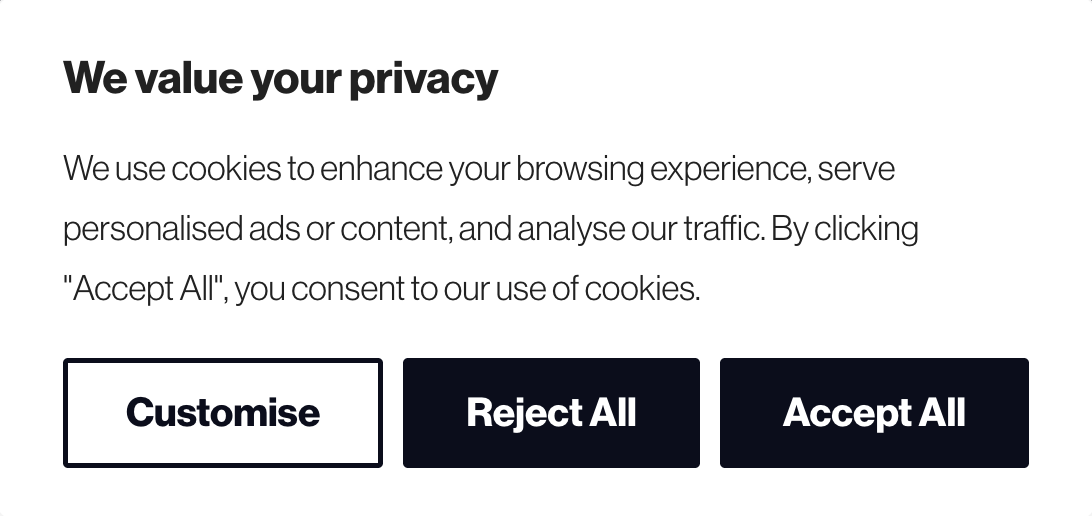
- Button Parity & Contrast: For GDPR, ensure ‘Accept All’ and ‘Reject All’ buttons have equal visual weight and contrasting colors. This directly addresses regulatory crackdowns on “dark patterns.” For CCPA/CPRA, the primary action should lead to either acceptance or an obvious path to ‘Manage Preferences’ to exercise the right to opt-out.
- Layered Information: Present core choices clearly on the first layer (Accept/Reject/Manage) and reserve granular detail for a secondary preference center. This streamlines the top-level experience while maintaining full legal transparency.
By implementing a legally robust, yet conversion-centric consent flow, you are not merely checking a compliance box. You are establishing your brand as a trustworthy entity from the initial impression. This commitment to transparent data practices yields a higher volume of legally qualified customer data, which is essential for accurate marketing segmentation, retargeting efficiency, and ultimately, sustainable WooCommerce revenue growth.
Ready to take your e-commerce to the next level?
The nuanced differences between GDPR, CCPA, and CPRA are more than mere legal hurdles; they are structural fault lines in your WooCommerce data architecture. If your customer retention efforts feel like they’re stalling revenue, or if you suspect you’re relying on low-quality, non-compliant data, the problem is not the regulation—it is a fragmented consent strategy. Blindly pursuing high ‘Accept All’ rates often contaminates your segmentation, devalues your entire marketing ecosystem, and ultimately compromises long-term Customer Lifetime Value (LTV).
Scaling a global or multi-state eCommerce operation demands that you transform legal complexity into a competitive advantage. Our consultancy acts as an extension of your in-house team, specializing in building unified, data-driven systems where advanced tracking, consent management, CRM, and marketing automation work together to maximize ROAS and predictable LTV. Stop building your growth on a foundation of legal risk and uncertainty. Schedule one of our data-driven & conversion-focused audits today to get a clear, actionable blueprint for compliant, high-profit data collection.