






Many brands operate under the comforting illusion that their standard SMTP setup is sufficient for scaling communication, believing that as long as emails are being sent, the job is done. But what if this reliance on basic infrastructure is actually acting as a silent ceiling on your revenue expansion? For high-growth eCommerce businesses, the hidden cost of inaction lies in the latency and deliverability gaps of legacy systems, which leave massive amounts of money on the table by failing to trigger critical, time-sensitive transactional messages at the exact moment of peak customer intent.
The hard reality is that manually managed email workflows or basic servers cannot support the sophisticated, data-driven logic required to maximize Customer Lifetime Value (LTV) in 2026. Transitioning to a robust Email API is not merely a developer’s preference; it is a strategic necessity that enables your application to programmatically send, receive, and track thousands of personalized confirmations with near-zero friction. This guide explores how integrating a modern Email API provides the critical infrastructure needed to eliminate technical debt and fuel automated workflow efficiency, ensuring every touchpoint becomes a driver for scalable growth.
What is an email API and how does it work?
An Email API (Application Programming Interface) is a programmatic bridge that allows your WooCommerce store or custom application to leverage a professional email infrastructure via code. Unlike manual sending or basic SMTP, an API enables your system to send, receive, and track messages by making simple HTTP requests. This eliminates the need for you to manage complex mail servers or worry about the low-level protocols of email delivery, shifting the heavy lifting to specialized providers who optimize for high inbox placement and speed.
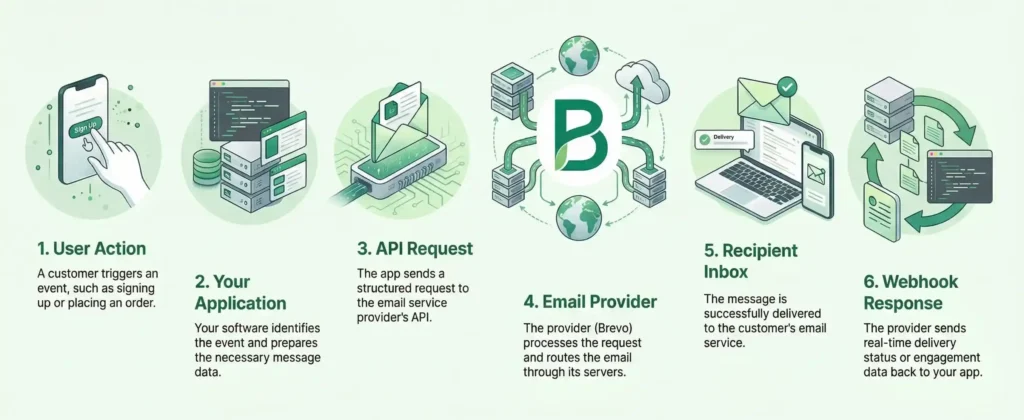
- The Request: Your application triggers an event, such as a new order, and sends a structured JSON payload containing the recipient data and content to the API endpoint.
- The Processing: The email service provider receives this request, validates the credentials, and instantly queues the message for delivery using their reputation-optimized IP addresses.
- The Feedback Loop: The API sends real-time data back to your application, providing granular insights into delivery status, open rates, and clicks, which can be used to trigger follow-up automated workflows.
For high-growth eCommerce brands, the transition from standard SMTP to an API-based architecture is a strategic move toward operational reliability. By moving away from the synchronous nature of SMTP, which can bottle-neck server resources during high-traffic sales events, an Email API ensures that mission-critical communications like password resets and order receipts are delivered with millisecond latency. This technical efficiency directly protects your customer experience and prevents the abandonment that occurs when transactional triggers fail to land in the inbox instantly.
Why should I use an email API for WooCommerce?
For high-growth WooCommerce stores, relying on the default WordPress mail server is a recipe for abandoned carts and lost revenue. An email API bypasses the limitations of standard server-side delivery, ensuring that mission-critical transactional messages—like password resets and order confirmations—reach the inbox with millisecond latency. When you scale from ten orders a day to thousands, the infrastructure provided by an API handles the volume without the performance bottlenecks or “not sending” errors common in basic SMTP configurations.
- Superior Deliverability: API providers maintain high-reputation IP addresses and utilize advanced authentication protocols like SPF, DKIM, and DMARC to ensure your WooCommerce notifications bypass spam filters.
- Granular Analytics: Unlike standard mailers, an API provides real-time tracking for opens, clicks, and bounces, allowing you to identify exactly where a customer journey is breaking down.
- Enhanced Security: By using API keys rather than storing plain-text SMTP credentials in your WordPress database, you significantly reduce the risk of your mail server being compromised for phishing or spam.
Transitioning to an email API is a strategic move to safeguard your Customer Lifetime Value (LTV). By isolating transactional traffic from marketing blasts, you ensure that even during heavy promotion periods, your customer’s receipt or tracking number is never delayed. This technical diligence builds brand trust and provides the robust foundation necessary for automated eCommerce scaling.
How to integrate an email API with my application?
Integrating an email API into your WooCommerce application is a strategic move that shifts the burden of delivery from your local server to a specialized infrastructure. Unlike the rigid configuration of SMTP, an API allows your application to communicate via HTTP requests, which are typically faster, more secure, and less prone to being throttled by hosting providers. For a high-growth store, this integration ensures that mission-critical messages—like password resets and order confirmations—are triggered programmatically and reach the inbox without latency.
- Authentication and Security: Generate unique API keys from your provider’s dashboard and store them securely as environment variables rather than hardcoding them. This ensures your sending reputation remains protected and access is restricted to authorized requests only.
- Webhook Configuration: Set up webhooks to receive real-time data from the API. This allow your application to automatically update order statuses or trigger recovery sequences based on specific events like bounces, delivery failures, or link clicks.
- Environment Testing: Utilize a staging environment to validate your JSON payloads and header formatting. Testing ensures that dynamic variables, such as customer names and unique coupon codes, are correctly parsed before pushing the integration to your live production site.
By following these technical steps, you move away from the limitations of legacy protocols and build a scalable communication bridge. This programmatic approach not only improves delivery rates but also provides the granular data needed to optimize every touchpoint of your customer journey, ultimately protecting your conversion rates and brand equity.

What are the benefits of email API vs SMTP for eCommerce?
For high-growth WooCommerce stores, the choice between an Email API and standard SMTP is often the difference between a scalable communications engine and a technical bottleneck. While SMTP is a reliable legacy protocol for basic mail transfer, it lacks the speed and data-rich feedback loops required for modern eCommerce. An Email API facilitates a much faster, more secure connection by allowing your store to send transactional data via HTTP, which significantly reduces the server overhead and “handshake” latency associated with traditional SMTP relays.
- Superior Deliverability and Speed: Unlike SMTP, which can be prone to timeouts during high-volume bursts like Black Friday, an Email API uses optimized infrastructure to process thousands of messages per second, ensuring order confirmations land in inboxes instantly.
- Advanced Analytics and Reporting: Email APIs provide deep, real-time insights into open rates, clicks, and bounces directly via webhooks, allowing you to automate follow-up actions based on customer behavior.
- Enhanced Security and Authentication: By utilizing API keys instead of standard login credentials, you gain granular control over access permissions, reducing the risk of credential leaks that could compromise your entire mail server.
Transitioning from SMTP to an Email API is a critical step in removing the “silent ceiling” on your revenue expansion. By offloading the complexity of mail delivery to a dedicated API provider, you ensure that your WooCommerce server remains focused on processing orders rather than managing a delivery queue. This shift not only improves the reliability of your transactional flows but also provides the technical foundation necessary to deploy sophisticated, event-driven marketing automation that maximizes Customer Lifetime Value.
How to use an email API to automate transactional emails?
Automating transactional emails via an email API transforms your WooCommerce store from a basic storefront into a high-performance communication engine. Unlike standard SMTP, which relies on a persistent connection, an API uses HTTP requests to trigger messages based on specific backend events. For high-growth brands, this means moving beyond the default WordPress mailer to a specialized infrastructure that ensures mission-critical data—like order receipts or password resets—bypasses the latency and deliverability hurdles associated with shared hosting servers.
To implement an automated transactional workflow effectively, developers and store owners should focus on the following technical integration points:
- Hook Identification: Map your automation to specific WooCommerce action hooks, such as woocommerce_order_status_completed or woocommerce_payment_complete, to ensure the API call triggers only when the transaction state is validated.
- Payload Optimization: Use JSON payloads to pass dynamic data (customer names, SKU details, tracking numbers) directly to your API provider’s templates, reducing the server-side processing load on your own application.
- Webhook Feedback Loops: Configure webhooks to listen for delivery events—such as bounces or drops—allowing your system to programmatically flag invalid customer data or trigger secondary SMS alerts when an email fails.
By delegating the delivery logic to a robust API, you gain granular control over the customer journey while maintaining the technical resilience needed to scale during high-traffic sales cycles. This approach ensures that every post-purchase touchpoint is handled with the speed and reliability required to build long-term brand equity.
Ready to take your e-commerce to the next level?
While understanding the technical definition and use cases of an email API is a critical first step, the business reality for high-growth WooCommerce brands is that infrastructure without strategy is a recipe for stagnant ROI. If your automated communications feel like they are stalling revenue expansion or if you suspect that latency in your transactional flows is eroding customer trust, you are facing a structural barrier to scale. Relying on basic SMTP or unoptimized API integrations is not just a developer’s preference; it is a direct compromise of your deliverability and your ability to capture revenue at the exact moment of peak customer intent.
To move beyond basic implementation and build a high-performance communication engine, you need a partner that synchronizes your technical backend with your broader growth objectives. We act as a strategic extension of your team, helping DTC brands maximize Profit, Retention, and LTV through data-driven systems where CRM, automation, and advanced tracking operate in perfect concert. Our process begins with rigorous, conversion-focused audits to eliminate guesswork and identify the exact bottlenecks in your customer journey. If you are ready to move from manual work to a scalable, API-driven system that maximizes ROAS, book a free consultation today.