






Revenue is vanity, profit is sanity — and contribution margin is the metric that reveals whether each sale actually moves your business forward. Unlike gross profit, contribution margin strips away every variable cost tied to an individual order, giving you a clear picture of how much cash each product truly generates. For WooCommerce stores scaling with paid media and marketing automation, this number determines which products deserve promotion, which campaigns are profitable, and where your pricing strategy leaks money. In this guide, you’ll learn the exact formula for calculating contribution margin, which variable costs to include, and how to use this metric to make smarter decisions about inventory, advertising, and revenue growth.
What Is Contribution Margin and Why Does It Matter for eCommerce?
Contribution margin is the revenue remaining from a single sale after all variable costs are deducted. Unlike fixed costs such as rent or software subscriptions, variable costs rise and fall with each order. This makes contribution margin the purest measure of a product’s ability to fund your business.
For eCommerce brands, this metric is essential because it reveals which products actually subsidise your fixed overhead and which ones drain resources. A high contribution margin means each sale generates substantial cash that can be reinvested in acquisition, retention, and growth. A negative contribution margin means you’re losing money on every transaction before fixed costs even enter the equation.
Key reasons to track it:
- Identifies your most profitable products and SKUs
- Reveals whether discounting destroys unit economics
- Guides budget allocation across paid media channels
- Supports data-driven pricing decisions
How to Calculate Contribution Margin for Your WooCommerce Store
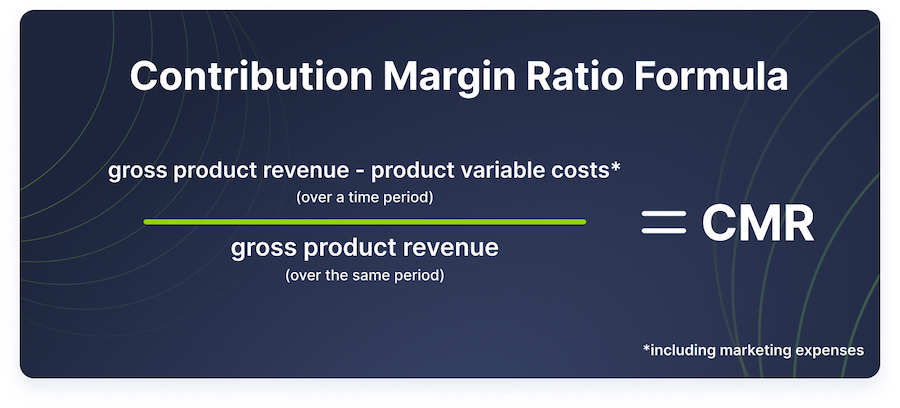
The formula is straightforward: Contribution Margin = Sale Price − Variable Costs per Unit. The challenge for eCommerce businesses is capturing every variable cost accurately, not just the obvious ones.
Start with your net sale price after discounts and returns. Then subtract your cost of goods sold, payment processing fees, shipping and fulfilment costs, packaging materials, and any channel-specific fees such as marketplace commissions or platform transaction charges. The result is your contribution margin per unit.
For WooCommerce merchants, this means pulling data from multiple sources:
- WooCommerce order reports for net revenue
- Your inventory system for COGS
- Stripe or PayPal for payment processing fees
- Your 3PL or shipping provider for fulfilment costs
What Variable Costs and Fees Should You Include in the Formula?
Many store owners undercount variable costs by focusing only on COGS. A complete contribution margin calculation must capture every cost that scales with order volume.
Variable costs to include:
- Cost of goods sold (COGS): the direct cost to produce or purchase the product
- Payment processing fees: typically 1.5% to 3% per transaction
- Shipping and fulfilment: outbound postage, packaging, and 3PL pick-and-pack fees
- Platform fees: WooCommerce payment processing, marketplace commissions, or app fees tied to order volume
- Returns and refunds: the average cost of processing a return per order
Excluding any of these inflates your contribution margin and leads to poor decisions about which products to promote or which campaigns to scale.
What Is the Difference Between Contribution Margin and Gross Profit?
Gross profit subtracts only COGS from revenue, while contribution margin subtracts all variable costs. This distinction is critical for eCommerce operators because gross profit can paint a deceptively rosy picture.
For example, a product with a 60% gross margin might seem like a star performer. But after accounting for €5 shipping, €2 packaging, and a 3% payment processing fee, the contribution margin could drop to 25% or lower. That difference determines whether a product can sustain paid acquisition.
When to use each metric:
- Gross profit: useful for supplier negotiations and manufacturing decisions
- Contribution margin: essential for marketing budget decisions, pricing strategy, and campaign profitability analysis
How to Use Contribution Margin Data to Optimize Marketing Spend
Contribution margin should drive every paid media decision. If your contribution margin per unit is €20 and your customer acquisition cost is €25, scaling that campaign will destroy cash regardless of how impressive the ROAS looks on paper.
Start by mapping contribution margin by product and channel. Use this data to set maximum allowable CAC thresholds for each SKU. Products with higher contribution margins can absorb more aggressive acquisition spending, while low-margin items may only be profitable through organic or retention channels.
For WooCommerce stores with marketing automation in place, contribution margin also shapes your upsell and cross-sell strategy:
- Promote high-contribution-margin products in abandoned cart flows
- Bundle low-margin items with high-margin anchors
- Use post-purchase upsells to improve average order value and offset fixed costs
Ready to take your e-commerce to the next level?
If your growth metrics look impressive on the dashboard but your bank account tells a different story, or if you’re scaling ad spend without knowing which products actually fund your overhead, contribution margin is the lens you need. Chasing revenue without understanding unit economics is how eCommerce brands burn cash while celebrating vanity milestones. The products you promote, the discounts you run, and the channels you scale should all be filtered through contribution margin — because profit, not sales volume, is what sustains a business.
We help DTC and eCommerce brands build data-driven systems where tracking, CRM, paid media, and automation work together to maximise ROAS, LTV, and long-term growth. Through our data-driven, conversion-focused audits, we analyse your contribution margin by product, channel, and customer segment to identify exactly where your profitability leaks and where your growth engine actually lives. If you’re ready to replace guesswork with numbers that matter, book a free marketing automation audit.