






Customer Acquisition Cost (CAC) is one of the most misunderstood metrics in growth marketing. Founders often ask, “is my CAC too high?” without a benchmark to compare against — and the honest answer is that a “good” CAC depends entirely on your margins, your average order value, and how long customers stick around. In this article, we’ll break down realistic CAC benchmarks for ecommerce and SaaS businesses, explain how the CAC-to-LTV ratio changes the equation, and show how marketing automation and WooCommerce integrations can bring your acquisition costs under control without sacrificing growth.
What Is a Good CAC-to-LTV Ratio for Ecommerce and SaaS Brands?
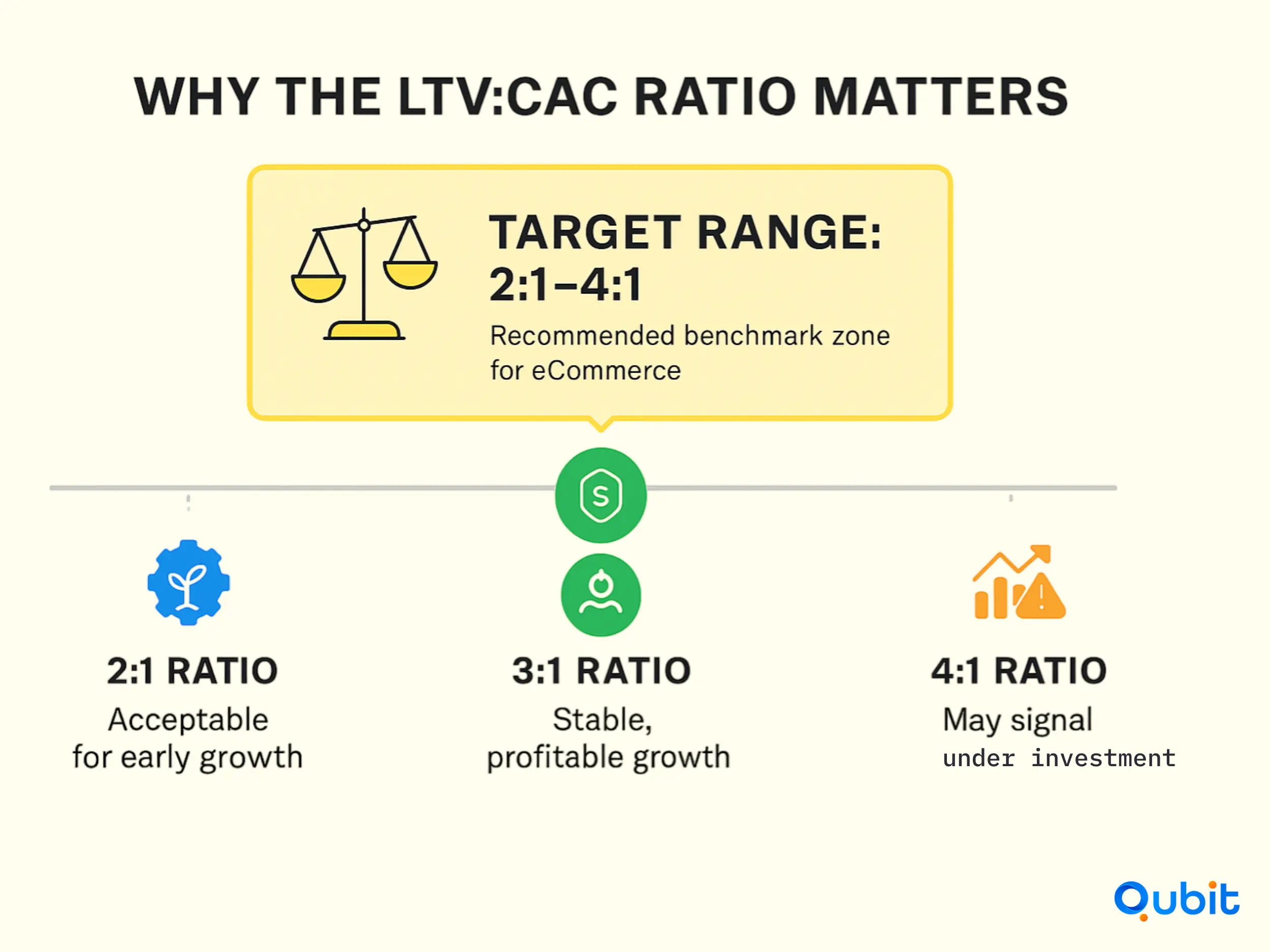
There’s no universal dollar figure that defines a “good” CAC — a $40 CAC could be excellent for a subscription box brand and disastrous for a low-margin commodity store. What matters is the relationship between CAC and Customer Lifetime Value (LTV). The widely cited benchmark, especially in SaaS, is an LTV:CAC ratio of at least 3:1, meaning every customer should generate three times what it cost to acquire them.
For ecommerce, the picture is more nuanced because purchase frequency and margin vary wildly by category:
- Subscription/consumable ecommerce: aim for LTV:CAC above 3:1, since repeat purchases compound over time.
- One-off, high-margin products: a 2:1 ratio can still be profitable if fulfillment costs are low.
- Low-margin, low-repeat categories: even a 1.5:1 ratio may require tightening before scaling paid spend.
SaaS businesses typically benchmark payback period alongside the ratio — a good rule of thumb is recovering CAC within 12 months. The key mistake we see brands make is chasing a “good” CAC in isolation, rather than pairing it with LTV, gross margin, and payback period to judge true profitability.
How Do You Calculate Customer Acquisition Cost Accurately?
Most brands underestimate their real CAC because they only count ad spend. An accurate calculation requires pulling in every cost associated with winning a customer, not just the media budget.
The full formula looks like this:
CAC = (Total Sales & Marketing Costs) ÷ (Number of New Customers Acquired)
That numerator should include:
- Paid media spend (Google Ads, Meta Ads, etc.)
- Marketing team salaries or agency retainers
- Marketing automation, CRM, and email/SMS platform costs
- Creative production and content costs
- Attribution and analytics tooling
A common blind spot is treating blended CAC (all channels combined) as the only metric worth tracking. In reality, you need channel-specific CAC to know where your budget is working hardest — a WooCommerce store running Meta Ads, Google Shopping, and email flows simultaneously needs to isolate each channel’s contribution using proper attribution and tracking, not just last-click data from a single platform. Without this granularity, you risk scaling the wrong channel while starving the one actually driving profitable growth.
Why Is Your CAC Rising Even When Ad Spend Stays the Same?
If your ad budget hasn’t changed but your CAC keeps climbing, the cause is rarely the platform itself — it’s usually a symptom of eroding efficiency somewhere else in the funnel. Rising CAC with flat spend is one of the clearest signals that something upstream needs attention.
Common culprits include:
- Audience fatigue: the same creative shown to the same segment loses performance over time, inflating cost per acquisition.
- Tracking degradation: privacy changes and cookie loss mean platforms are optimizing on incomplete data, leading to wasted spend.
- Weak on-site conversion rate: if traffic quality is stable but conversion rate drops, CAC rises mathematically even though the ad platform is unchanged.
- Poor retention pulling down average order economics: when repeat purchase rate declines, marketers often compensate by front-loading budget into new customer acquisition, pushing blended CAC up.
The fix is rarely “spend more” — it’s usually a combination of first-party data collection, consent-compliant tracking, and CRO improvements on the WooCommerce storefront itself. Brands that invest in server-side tracking and clean first-party data tend to see CAC stabilize faster than those relying purely on platform-reportd numbers, because their ad platforms simply have better signal to optimize against.
How Can Marketing Automation Lower Your Customer Acquisition Cost?
Marketing automation doesn’t just improve retention — it directly reduces CAC by increasing the value extracted from every visitor and lead, which lowers the effective cost per acquired customer even if ad spend stays flat.
Here’s how automation moves the CAC needle in practice:
- Abandoned cart and browse abandonment flows recover revenue from traffic you already paid to acquire, rather than requiring fresh ad spend to replace it.
- Welcome and nurture flows convert cold leads into first-time buyers without additional media cost.
- Post-purchase flows increase repeat purchase rate, which improves LTV and therefore your LTV:CAC ratio even if raw acquisition cost doesn’t change.
- Segmentation-based email/SMS campaigns improve conversion rate on existing lists, reducing reliance on paid acquisition for revenue growth.
For WooCommerce brands specifically, integrating your store data directly into your CRM and automation platform means flows can trigger on real purchase behavior, not just generic email signups — this precision is what separates a marginal automation setup from one that measurably lowers blended CAC. Brands that treat automation as a revenue lever, not just a retention tactic, consistently see acquisition efficiency improve as a byproduct.
When Should You Worry About a High CAC?
A rising CAC isn’t automatically a crisis — but there are specific thresholds where it becomes a genuine profitability risk rather than a normal cost of scaling.
You should be concerned when:
- Your LTV:CAC ratio drops below 2:1 and shows no sign of recovering over several months.
- Payback period extends beyond your cash flow tolerance — for most ecommerce brands, that’s 3-6 months; for SaaS, typically 12 months.
- CAC is rising faster than average order value or LTV, meaning the gap between cost and return is actively shrinking.
- You’re relying on discounting to hit acquisition targets, which inflates apparent CAC efficiency while quietly destroying margin.
Conversely, a temporarily elevated CAC isn’t automatically bad if it’s tied to deliberate market expansion, new channel testing, or brand-building spend expected to pay off over a longer horizon. The key is distinguishing between a strategic, monitored increase and an unmanaged drift caused by tracking gaps, funnel leaks, or retention decline. Regular CAC audits — reviewed alongside LTV, payback period, and retention cohorts — are what separate brands that catch the problem early from those that only notice once profitability has already destróid.
Ready to take your e-commerce to the next level?
If your CAC keeps creeping up and you’re not entirely sure why, or if you suspect you’re pouring budget into acquiring customers who never come back, the number itself isn’t the real problem — it’s usually a sign that tracking, retention, and automation aren’t working together the way they should. Chasing a lower CAC in isolation, without looking at LTV, margin, and channel-level attribution, is how brands end up optimizing for the wrong outcome entirely.
This is exactly the kind of gap we help DTC and ecommerce brands close. As an extension of your in-house team, we build data-driven systems where tracking, consent, CRM, paid media, and marketing automation work together to maximise ROAS and LTV — not just cut acquisition cost on paper. If you want a clear, honest read on where your CAC is really coming from and what’s driving it, book a free marketing automation audit and let’s run the numbers with a data-driven, conversion-focused review.