






Cross-selling is one of the most reliable ways to grow average order value without spending an extra dollar on acquisition — yet most ecommerce brands still execute it as an afterthought, bolting on generic “customers also bought” widgets and hoping for the best. In this article, we’ll define cross-selling, distinguish it clearly from upselling, and explain how a properly automated cross-sell strategy — powered by segmentation and behavioral data — can meaningfully lift revenue per customer. We’ll also look at where WooCommerce brands typically get cross-selling wrong, and how to fix it.
What Is Cross-Selling in Ecommerce?
Cross-selling is the practice of recommending complementary or related products alongside the item a customer is already buying or viewing. Rather than trying to sell a more expensive version of the same product, cross-selling widens the basket — a customer buying a camera gets offered a memory card, a case, or a spare battery.
The mechanics are straightforward, but effective execution depends on relevance and timing. A good cross-sell feels helpful, not pushy, because it’s genuinely useful to the customer’s purchase.
Cross-selling typically shows up at three points in the customer journey:
- On the product page: “frequently bought together” or “you may also need” sections.
- At checkout: low-cost, high-relevance add-ons presented right before purchase.
- Post-purchase: email or SMS flows suggesting complementary products after the first order ships.
For WooCommerce stores, cross-sell relationships can be configured natively at the product level, but the real revenue impact comes from layering behavioral data and purchase history on top of static product linking — so recommendations adapt to what a specific customer actually needs, not just what’s manually tagged as “related.”
Cross-Sell vs Upsell: What’s the Real Difference?
Cross-selling and upselling are frequently used interchangeably, but they target different psychological triggers and different points in the buying decision — confusing the two leads to poorly designed offers that convert badly.
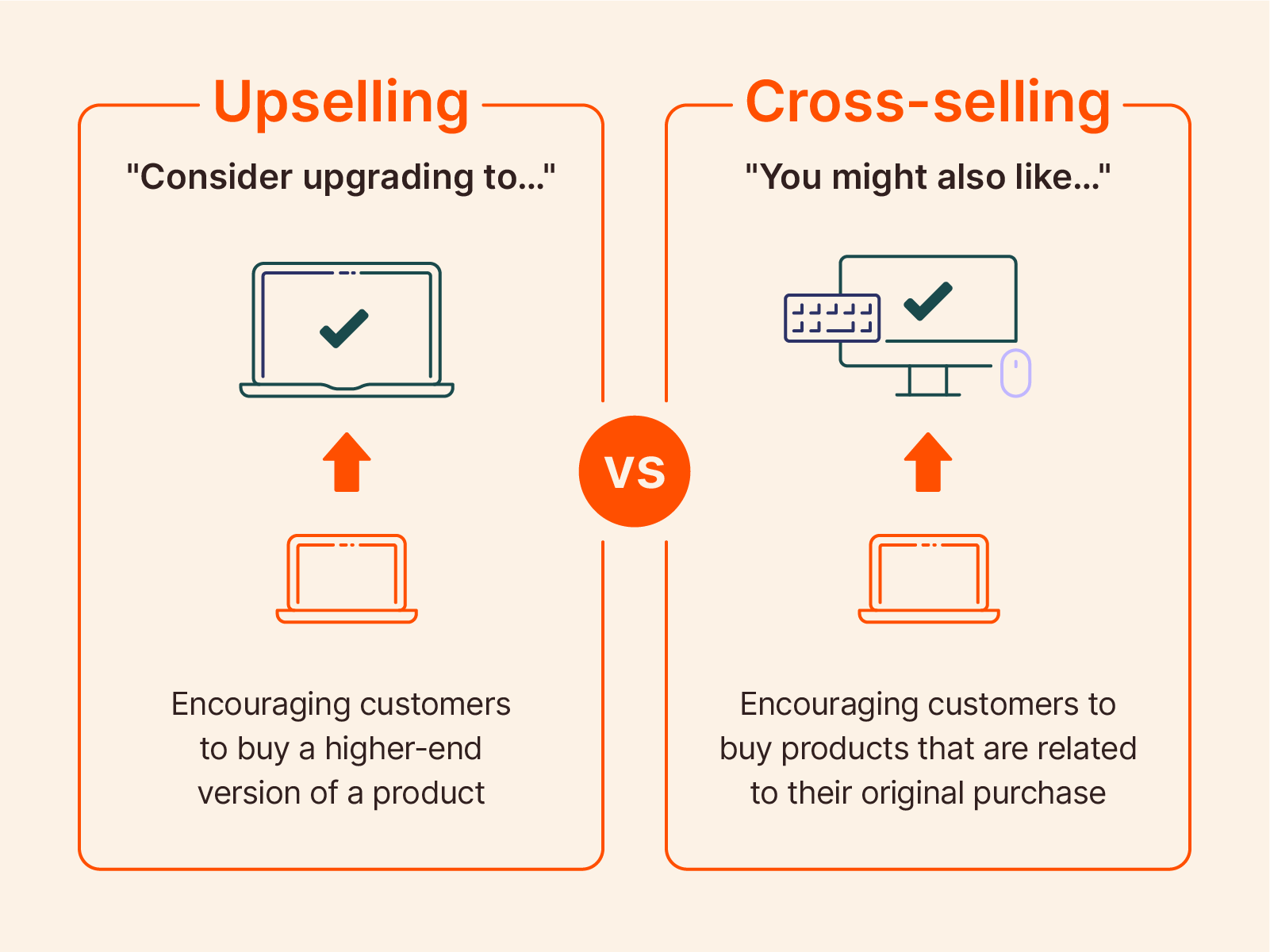
Upselling encourages the customer to buy a better, usually more expensive, version of the product they’re already considering — think upgrading from a standard blender to a premium model with a longer warranty. Cross-selling, by contrast, keeps the original product the same and instead adds complementary items to the basket. The key distinctions:
- Upsell: same product category, higher price tier, deeper commitment.
- Cross-sell: different but related product category, additive rather than substitutive.
- Upsell typically happens earlier in the decision (before checkout), while cross-sell works well both pre- and post-purchase.
- Upsell increases the value of a single item; cross-sell increases the number of items in the order.
Both tactics aim to lift average order value, but they require different messaging. Upsell copy should emphasize superior value and long-term benefit; cross-sell copy should emphasize convenience, completeness, or “you’ll need this too.” Brands that blur the two — for example, offering an unrelated “upgrade” as a cross-sell — tend to see lower click-through and conversion, because the recommendation doesn’t match the customer’s mental model of what they’re doing at that moment.
How Does Cross-Selling Actually Increase Revenue?
Cross-selling increases revenue primarily by raising average order value (AOV), but its real financial impact goes further than a single transaction — it also strengthens margin and can improve retention when done with genuine relevance. The revenue mechanics work in a few ways:
- Higher AOV per transaction — the most direct effect; more items per order without additional acquisition spend.
- Improved margin mix — accessories and complementary items often carry higher margins than the core product, so a well-designed cross-sell can lift blended profitability, not just top-line revenue.
- Reduced future acquisition cost — a customer who receives a genuinely useful complementary product recommendation is more likely to trust future recommendations, improving repeat purchase rate.
The scale of the effect depends heavily on execution quality. A generic, poorly targeted cross-sell offer might lift AOV marginally while annoying customers; a well-segmented, behavior-triggered offer can meaningfully move both AOV and long-term LTV. This is where automation matters — a WooCommerce store integrated with a CRM and marketing automation platform can trigger cross-sell offers based on actual purchase history and browsing behavior, rather than relying on static, one-size-fits-all product pairings that ignore who the customer actually is.
When Should You Show a Cross-Sell Offer?
Timing determines whether a cross-sell feels like a helpful suggestion or an intrusive distraction. Showing the right offer at the wrong moment can actually suppress conversion rather than lift it.
The three highest-performing moments for cross-sell offers are:
- Product page: works well for browsers still deciding, since it frames the complementary item as part of a complete solution.
- Cart or checkout: most effective for low-friction, low-cost add-ons — the closer to purchase, the smaller and more obvious the offer needs to be.
- Post-purchase (email/SMS): ideal for higher-consideration complementary products, since the customer has already committed and isn’t being asked to make two decisions at once.
A common mistake is showing the same cross-sell offer at every stage regardless of context. A checkout-stage offer needs to be near-frictionless — a $5 accessory add-on with one click — while a post-purchase email flow can afford a more considered pitch with more information, since the customer isn’t mid-transaction. Brands that automate this sequencing, rather than manually managing static rules, typically see stronger performance because offers can be triggered dynamically based on what’s actually in the cart or what was just purchased, rather than a fixed, generic rule applied to everyone.
How Can You Automate Cross-Selling in WooCommerce?
Manually managing cross-sell offers across product pages, checkout, and post-purchase email is unsustainable past a handful of SKUs — automation is what makes cross-selling scalable and genuinely personalized rather than static and generic. Effective automation typically involves:
- Native WooCommerce cross-sell fields for baseline product-page relationships, as a starting point rather than the whole strategy.
- CRM-triggered post-purchase flows that recommend complementary products based on what was actually bought, timed to when the customer is likely to need the add-on.
- Segmentation by purchase history, so recurring customers see different cross-sell logic than first-time buyers.
- Behavioral triggers based on browsing activity, not just completed purchases, to catch intent before the customer leaves the site.
The brands that get the most from cross-selling treat it as a data problem, not a merchandising afterthought — connecting WooCommerce order and customer data directly into a marketing automation platform so offers stay relevant as purchase history grows, rather than relying on static rules that go stale.
Ready to take your e-commerce to the next level?
If your cross-sell offers feel like an afterthought bolted onto the checkout page, or if you suspect your “related products” widget hasn’t actually moved AOV in months, the problem usually isn’t the tactic — it’s the lack of data behind it. Generic, one-size-fits-all recommendations rarely outperform doing nothing, and plenty of brands are leaving margin on the table without realizing it.
This is exactly the kind of gap we help DTC and ecommerce brands close. As an extension of your in-house team, we build data-driven systems where tracking, consent, CRM, paid media, and automation work together to maximise ROAS, LTV, and long-term growth. If you want to see what a properly automated, behavior-driven cross-sell strategy could do for your average order value, book a free marketing automation audit — our approach is always data-driven, conversion-focused, no guesswork.