





Many eCommerce brands operate under the comforting illusion that having a legal disclaimer buried in their footer is enough to secure their revenue, believing that as long as the text is there, the risk is mitigated. But what if this reliance on surface-level documentation is actually a ticking time bomb for your scaling efforts? For high-growth businesses, the hidden cost of inaction isn’t just a potential fine; it is the erosion of customer trust and the structural vulnerability that occurs when your data practices don’t match your promises, effectively stalling your LTV expansion and leaving your most valuable retention channels like Email and SMS marketing exposed to catastrophic legal disruption.
The hard reality is that in 2025, privacy policies can no longer just live on your website—they must live in your operations. Transitioning from intent to day-to-day compliance through a rigorous CCPA audit is not merely a legal hurdle; it is a strategic necessity that bridges the gap between technical infrastructure and regulatory requirements. This guide explores the essentials of a comprehensive CCPA diagnostic, providing the roadmap to audit your data flows and tighten vendor contracts, ensuring your business has the reliable foundation needed to eliminate technical debt and fuel sustainable, long-term growth.
What is a CCPA audit and how does it work?
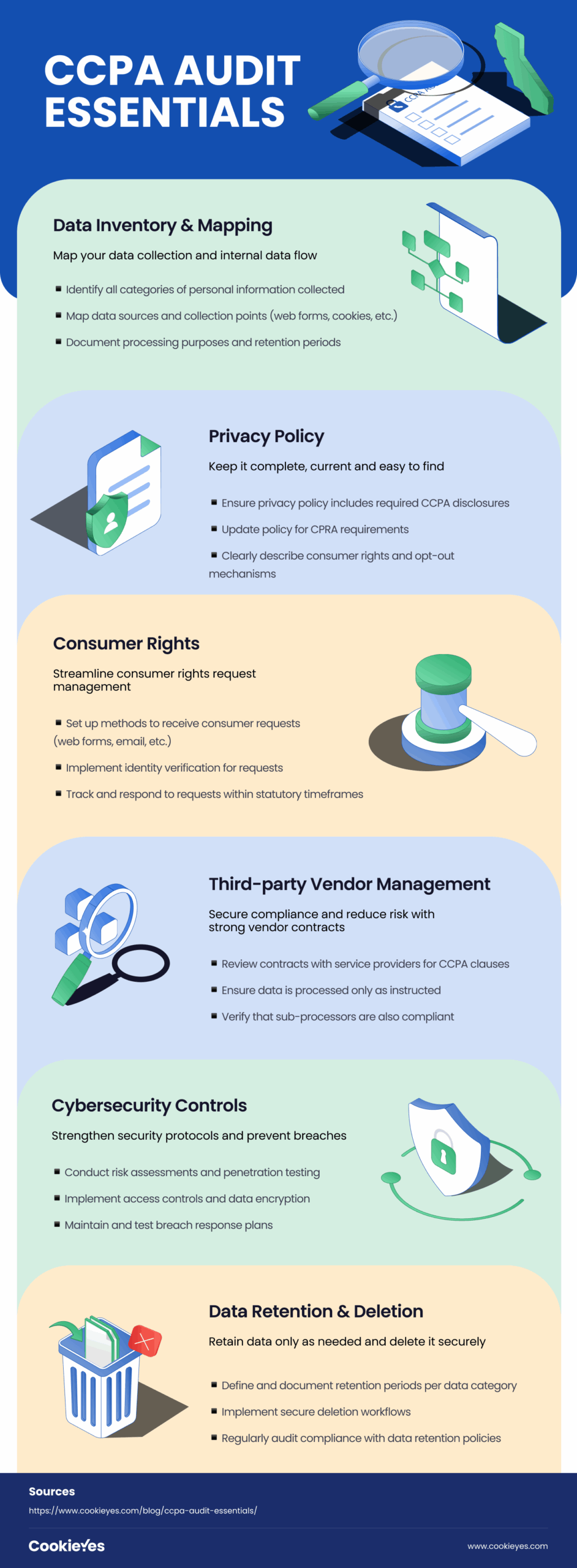
A CCPA audit is a formal evaluation designed to verify that your WooCommerce store’s operational handling of personal information (PI) aligns with the legal requirements of the California Consumer Privacy Act. Unlike a static privacy policy, an audit functions as a technical and administrative stress test, ensuring that data collection, processing, and retention practices are actually being executed as promised. For eCommerce brands, this involves mapping every data touchpoint—from checkout fields and marketing pixels to third-party shipping plugins—to identify and remediate any compliance gaps before they lead to regulatory scrutiny or legal liability.
- Data Mapping: The auditor identifies what California consumer data is collected, where it is stored in your database (such as wp_users or wp_postmeta), and which third-party service providers have access to it.
- Technical Verification: This phase tests the functional efficiency of your privacy controls, ensuring that “Do Not Sell or Share” signals are correctly honored by your analytics and advertising SDKs and that data deletion requests actually purge the information from all backup systems.
- Contractual Review: The audit examines vendor agreements to ensure they contain necessary CCPA/CPRA restrictive language, preventing contractors from using your customer data for their own independent purposes.
The process concludes with a detailed report that highlights specific vulnerabilities, such as unauthenticated data access or inadequate consent logging for sensitive personal information. For businesses meeting the significant-risk thresholds, this audit must be conducted by an independent professional and culminates in a formal certification submitted to the California Privacy Protection Agency (CPPA). This proactive documentation not only ensures regulatory alignment but also serves as a critical defense in the event of a data breach litigation.
Why is CCPA compliance important for WooCommerce stores?
For high-growth WooCommerce stores, CCPA compliance is a fundamental requirement of modern digital operations rather than a simple legal checkbox. Because the law applies based on the customer’s location, any store processing data from California residents must adhere to strict transparency and data minimization standards. Failing to align your technical infrastructure with these mandates exposes your business to significant financial penalties and irreversible damage to brand trust, which is the primary driver of Customer Lifetime Value (LTV).
- Mitigating Financial Risk: Intentional violations can result in civil penalties of up to $7,500 per incident, which can scale rapidly across a large customer database.
- Managing Plugin Vulnerabilities: WooCommerce environments often rely on third-party tracking scripts and marketing integrations that may collect data without valid consent, making active auditing essential to prevent unauthorized data “sharing.”
- Preserving Brand Authority: Proactive compliance signals professionalism and security, fostering a trustworthy shopping environment that distinguishes your store from competitors with opaque data practices.
Transitioning from a passive privacy policy to an operationalized CCPA strategy ensures that your data flows—from checkout forms to email marketing triggers—are fully compliant. By conducting regular audits and implementing automated compliance tools, store owners can eliminate the “silent ceiling” on their growth caused by regulatory uncertainty and ensure that their revenue expansion is built on a secure, legally resilient foundation.
How to conduct a CCPA data audit for eCommerce automation?
Conducting a CCPA data audit within a WooCommerce environment requires a shift from viewing privacy as a static policy to treating it as an operational workflow. For high-growth stores, the audit must focus on the technical infrastructure of data movement, specifically how customer information is ingested via the checkout process and subsequently distributed to third-party automation tools. An effective audit identifies every point of data collection and ensures that each automated trigger—whether for abandoned cart recovery or personalized marketing—aligns with the consumer’s right to opt-out and their right to delete.
- Data Mapping and Inventory: Catalog every plugin and external API that interacts with your WooCommerce database. You must document exactly what personal information, such as IP addresses or purchase history, is being synchronized with third-party platforms to ensure your data inventory is current and defensible during a regulatory inquiry.
- Automated Opt-Out Synchronization: Verify that “Do Not Sell or Share My Personal Information” requests are programmatically communicated to your automation stack. A CCPA audit check should confirm that if a customer opts out on your storefront, your marketing automation and CRM tools instantly stop processing that data for targeted advertising.
- Verification of Service Provider Contracts: Review the Data Processing Agreements (DPAs) with your automation vendors. Under the CPRA amendments, these tools must be classified as “service providers” with specific contractual restrictions that prevent them from using your customer data for their own purposes outside of the services they provide to your store.
To ensure long-term stability and audit readiness, your WooCommerce store should implement continuous monitoring rather than relying on annual checks. By embedding evidence capture directly into your data processing workflows, you create a unified visibility layer that allows you to demonstrate compliance in real-time. This proactive approach not only mitigates financial risk from regulatory enforcement but also strengthens brand trust by proving that privacy is integrated into the core of your eCommerce operations.

When does my WooCommerce business need a CCPA audit?
For high-growth WooCommerce brands, the transition from a small-scale storefront to a significant market player brings strict legal obligations under the CCPA and its expanded version, the CPRA. Statutorily, your business requires a formal audit if it meets specific thresholds, such as having annual gross revenues exceeding $25 million or processing the personal information of 100,000 or more California residents or households. However, the strategic reality is that you should initiate a diagnostic review whenever your store’s data architecture undergoes significant changes that could lead to unmapped data flows or “shadow” data storage within your plugin ecosystem.
- Infrastructure Migrations: When moving your store to a new server environment or implementing headless commerce architectures that decentralize where customer data is processed and stored.
- Marketing Stack Expansion: If you are integrating advanced behavioral tracking pixels, third-party analytics, or automated CRM workflows that share high volumes of customer data with external vendors.
- Contractual Renewals: Before signing new service agreements with data processors or brokers, ensuring that your vendor contracts are tightened to reflect current operational practices.
Ultimately, a CCPA audit is necessary whenever your data collection practices have outpaced your existing privacy documentation. If you cannot instantly identify every third-party script currently firing on your checkout page or track exactly where a customer’s data is shared across your marketing automation suite, your business is facing a structural liability. Conducting an audit at these critical growth junctions ensures that compliance is integrated into your day-to-day operations, protecting your brand from the latency and deliverability gaps that arise from unmanaged technical debt.
How to ensure CCPA compliance in email marketing workflows?
For high-growth WooCommerce stores, email marketing is a primary source of customer data collection, making it a critical focus area for CCPA compliance. Ensuring your workflows are compliant requires moving beyond a simple “unsubscribe” link; you must integrate technical mechanisms that honor consumer rights—such as the right to delete or the right to opt-out of data sales—directly into your automated sequences. Failure to sync your email service provider (ESP) with your store’s backend data can lead to significant regulatory risk if a customer’s deletion request in one system fails to propagate to your marketing lists.
- Automated Data Mapping: Audit your WooCommerce checkout and lead capture forms to ensure that every piece of personal information collected—from email addresses to behavioral engagement metrics—is categorized and mapped to your privacy policy’s data disclosure requirements.
- Verification-First Requests: Implement a standardized intake process for Data Subject Access Requests (DSARs) that utilizes secure authentication, such as account login or email verification, to prevent the unauthorized disclosure of consumer data to fraudulent requesters.
- Synchronized Deletion Logic: Configure webhooks between your WooCommerce store and your marketing automation platform to ensure that when a customer exercises their “Right to Deletion,” their personal information is programmatically scrubbed from all secondary databases and third-party vendor logs within the mandated 45-day window.
By treating compliance as an operational workflow rather than a static legal requirement, you protect your brand’s authority and maintain a resilient foundation for revenue expansion. Implementing these technical safeguards ensures that your email marketing remain a high-leverage growth tool without becoming a liability during a CCPA audit.
Ready to take your e-commerce to the next level?
While mastering the technical nuances of a CCPA audit is a critical first step, the business reality for high-growth WooCommerce brands is that privacy compliance without operational integration is a recipe for catastrophic legal and financial risk. If your data management efforts feel like they are stalling growth, or if you suspect that fragmented consent tracking is eroding your ability to leverage first-party data, you are facing a structural ceiling on your scale. Relying on superficial privacy policies rather than deep operational audits is not just a compliance oversight; it is a direct compromise of your brand integrity and your long-term ability to maintain a sustainable, high-performance customer engine.
To move beyond basic legal checklists and build a privacy-first growth system, you need a partner that synchronizes your technical infrastructure with your broader profit objectives. We act as a strategic extension of your team, helping DTC brands maximize Profit, Retention, and LTV through data-driven systems where tracking, consent management, and automation operate in perfect, compliant concert. Our methodology is centered on rigorous, conversion-focused audits that eliminate guesswork and identify the exact bottlenecks in your data flows. If you are ready to transition from manual compliance tasks to a scalable, automated system that maximizes ROAS while ensuring total data integrity, book a free consultation today.