


A healthy-looking open rate can mask a deliverability problem that’s quietly costing you revenue — because if a meaningful share of your list never receives your emails in the first place, no amount of subject-line optimization will fix the underlying issue. Delivery rate is one of the most overlooked email metrics in ecommerce, largely because it’s assumed to be near 100% by default. In this article, we’ll break down what counts as a good email delivery rate, how it differs from deliverability more broadly, what causes it to slip, and how proper list hygiene and sender reputation management keep your campaigns actually landing in the inbox.
What Is a Good Email Delivery Rate for Ecommerce Campaigns?
Delivery rate measures the percentage of sent emails that are accepted by the recipient’s mail server, as opposed to bouncing outright. It’s a narrower metric than overall deliverability, but it’s the foundation everything else depends on — an email that doesn’t deliver can’t be opened, clicked, or converted, regardless of how good the campaign content is. Generally accepted benchmarks for ecommerce senders:
- 95% or higher is considered a healthy delivery rate for a well-maintained list.
- 98%+ is achievable and typical for brands with strong list hygiene and consistent sending practices.
- Below 95% signals a problem worth investigating — whether it’s list quality, sender reputation, or technical email authentication issues.
The distinction worth understanding is that delivery rate only tells you whether the email was accepted by the receiving server — it says nothing about whether it landed in the inbox versus the spam folder. A brand can have a 98% delivery rate and still see poor inbox placement if sender reputation is weak, which is why delivery rate should be tracked alongside inbox placement and engagement metrics rather than treated as a complete deliverability picture on its own. Delivery rate is the floor, not the ceiling, of a healthy email program.
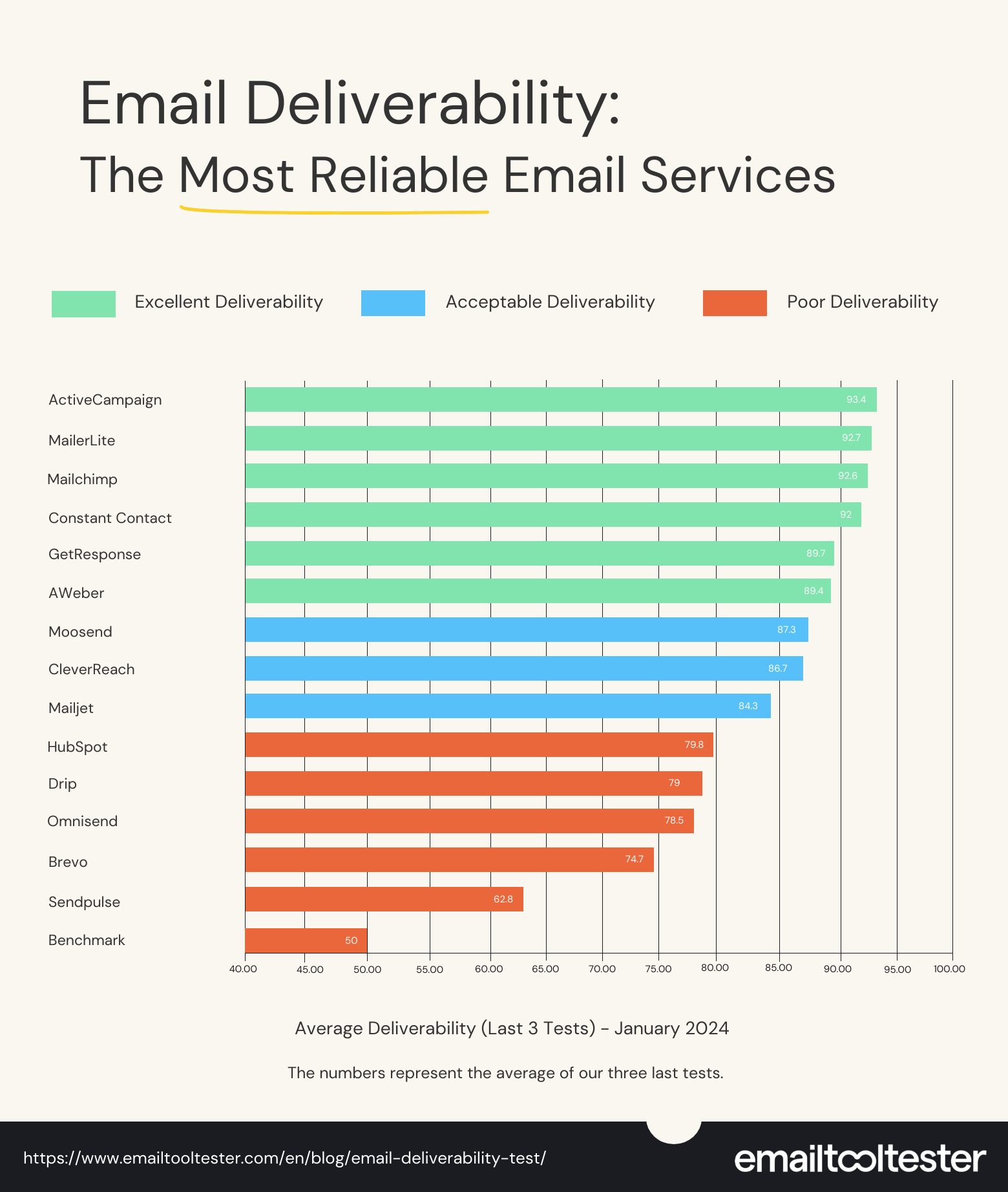
How Is Email Delivery Rate Different From Deliverability and Open Rate?
These three terms get used interchangeably, but they measure fundamentally different things — and conflating them leads to a false sense of security when one metric looks healthy while another is quietly deteriorating. The distinctions:
- Delivery rate: the percentage of emails accepted by the recipient’s mail server (not bounced). This is a binary, technical measurement.
- Deliverability: a broader concept encompassing whether emails actually reach the inbox versus spam/promotions folders, factoring in sender reputation, authentication, and engagement history — not something a single metric fully captures.
- Open rate: the percentage of delivered emails that are opened, which depends on subject line, sender name, and — critically — whether the email actually reached the inbox in the first place, making it partially dependent on deliverability rather than purely a content metric.
A common mistake is treating a strong delivery rate as proof of strong deliverability. An email can be technically “delivered” while landing in spam, in which case it counts toward delivery rate but contributes nothing to actual campaign performance. This is why declining open rates alongside a stable delivery rate is often the clearest early signal of an inbox placement problem — the emails are being accepted by the server but increasingly routed away from where recipients will see them.
Why Is Your Email Delivery Rate Declining?
A declining delivery rate is almost always a symptom of an underlying sender reputation or list quality issue, rather than a random technical glitch — and identifying the specific cause is essential before attempting a fix. The most common causes:
- Sending to invalid or outdated email addresses: purchased or old, unverified lists accumulate addresses that no longer exist, driving up hard bounces and damaging sender reputation.
- Consistently low engagement: mailbox providers use engagement (opens, clicks, deletions without opening) as a signal for filtering — a list full of disengaged subscribers trains providers to route future sends to spam.
- Sudden volume or frequency spikes: dramatically increasing send volume or frequency without a gradual warm-up can trigger spam filtering, especially from a newer sending domain.
- Missing or misconfigured email authentication: SPF, DKIM, and DMARC records that aren’t properly set up make it harder for receiving servers to verify the sender is legitimate, increasing bounce and spam-folder placement.
- High spam complaint rates: recipients marking emails as spam, even if they technically opted in, signals to mailbox providers that content isn’t wanted, directly damaging sender reputation over time.
The assumption worth challenging is that delivery problems are primarily a technical fix. In most cases, the root cause is list quality and engagement behavior accumulated over time, which means the fix requires addressing sending practices and audience health, not just adjusting a technical setting once and expecting the problem to resolve.
How Can List Hygiene Improve Your Delivery Rate?
List hygiene — the ongoing practice of maintaining a clean, engaged subscriber list — is one of the highest-leverage levers for improving delivery rate, because sender reputation is built cumulatively from how mailbox providers observe your list behaving over time. Practical list hygiene practices that meaningfully improve delivery rate:
- Regularly remove hard bounces, since continuing to send to invalid addresses directly damages sender reputation with every attempt.
- Suppress or re-engage long-term inactive subscribers, since consistently low engagement from a segment of the list drags down aggregate deliverability signals for the entire list.
- Use double opt-in for new subscribers, reducing the volume of invalid or mistyped addresses entering the list in the first place.
- Segment sending by engagement level, so highly engaged subscribers receive frequent sends while disengaged segments receive reduced frequency or targeted win-back attempts instead.
- Monitor spam complaint rates closely, treating a rising complaint rate as an early warning sign rather than something to address only after delivery rate has already declined.
For WooCommerce brands, list hygiene works best when it’s connected to actual purchase and engagement data — a customer who hasn’t opened an email in six months but continues purchasing may warrant different treatment than someone who’s both disengaged and inactive on-site. Static list cleaning performed occasionally is far less effective than an ongoing, data-connected hygiene process that adapts as subscriber behavior changes.
Can Marketing Automation Help Protect and Improve Email Delivery Rate?
Marketing automation platforms play a direct role in delivery rate, not just campaign content — because automated engagement-based segmentation and sending logic are what keep sender reputation healthy over the long term, rather than requiring manual list management. Ways automation protects and improves delivery rate:
- Automated engagement-based segmentation, dynamically adjusting who receives which sends based on real-time open and click behavior, rather than static segments that go stale.
- Automated suppression rules, removing hard bounces and chronically unengaged addresses from active sending without requiring manual list audits.
- Win-back flows for at-risk subscribers, attempting re-engagement before suppressing entirely, which protects list value while still safeguarding sender reputation.
- Sending frequency logic tied to engagement tier, avoiding the volume spikes and blanket sends that tend to trigger spam filtering.
- Authentication and infrastructure monitoring as part of a properly maintained platform, reducing the risk of technical misconfiguration silently degrading delivery over time.
For WooCommerce stores, the strongest setups connect purchase behavior directly into these automated deliverability safeguards — a purchasing customer who’s gone quiet on email is a fundamentally different signal than a non-purchasing subscriber who’s disengaged everywhere, and automation that can distinguish between the two protects both revenue and sender reputation more effectively than a one-size-fits-all suppression rule.
Ready to take your e-commerce to the next level?
If your delivery rate looks fine on paper but your open rates and email revenue have been quietly sliding, the real issue is often deliverability, not delivery — and that distinction matters more than most dashboards make clear. A technically “delivered” email that’s landing in spam is functionally the same as one that never sent at all.
This is exactly the kind of gap we help DTC and ecommerce brands close. As an extension of your in-house team, we build data-driven systems where CRM, marketing automation, and consent-compliant data collection work together to protect sender reputation and keep your campaigns actually reaching the inbox — not just technically delivered. If you want an honest read on what’s happening to your email deliverability, book a free marketing automation audit and get a data-driven, conversion-focused view of your current sending health.



Comments