


Customer Lifetime Value (LTV) gets cited constantly as the metric that matters most for sustainable growth, yet most founders asking “what’s a good LTV?” are asking a question that can’t be answered with a single dollar figure. LTV only becomes meaningful when it’s measured against what it cost to acquire that customer and how quickly the business needs to recover that investment. In this article, we’ll break down realistic LTV benchmarks, explain why LTV:CAC ratio matters more than LTV in isolation, and show how retention and automation directly determine whether your LTV is actually healthy or just a number that looks good on a slide.
What Is a Good Customer Lifetime Value Benchmark?
There’s no universal LTV figure that applies across ecommerce, because LTV is a function of average order value, purchase frequency, and customer lifespan — three variables that differ enormously by category. A skincare subscription brand and a mattress company will never have comparable LTV numbers, and comparing them directly is meaningless. That said, some general reference points are useful starting context:
- Consumables and subscription-model brands: often see LTV several multiples of average order value, since repeat purchase frequency is baked into the business model.
- Considered, infrequent-purchase categories (furniture, appliances, electronics): LTV tends to sit closer to 1-2x average order value, since repeat purchases are naturally rare.
- Mid-frequency categories (apparel, beauty, home goods): LTV commonly lands in the 2-4x AOV range over a 12-24 month window, depending heavily on retention quality.
The mistake most brands make is benchmarking their LTV against an industry-wide average pulled from an unrelated category. What matters more is tracking your own LTV trend over time, segmented by acquisition channel and cohort — because a rising or falling LTV relative to your own baseline tells you far more about business health than a static comparison to a number that was never calculated the same way twice across sources.
How Do You Calculate Customer Lifetime Value Accurately?
Most brands underestimate the complexity of an accurate LTV calculation, either oversimplifying it into a single formula or projecting it from too little purchase history to be reliable.
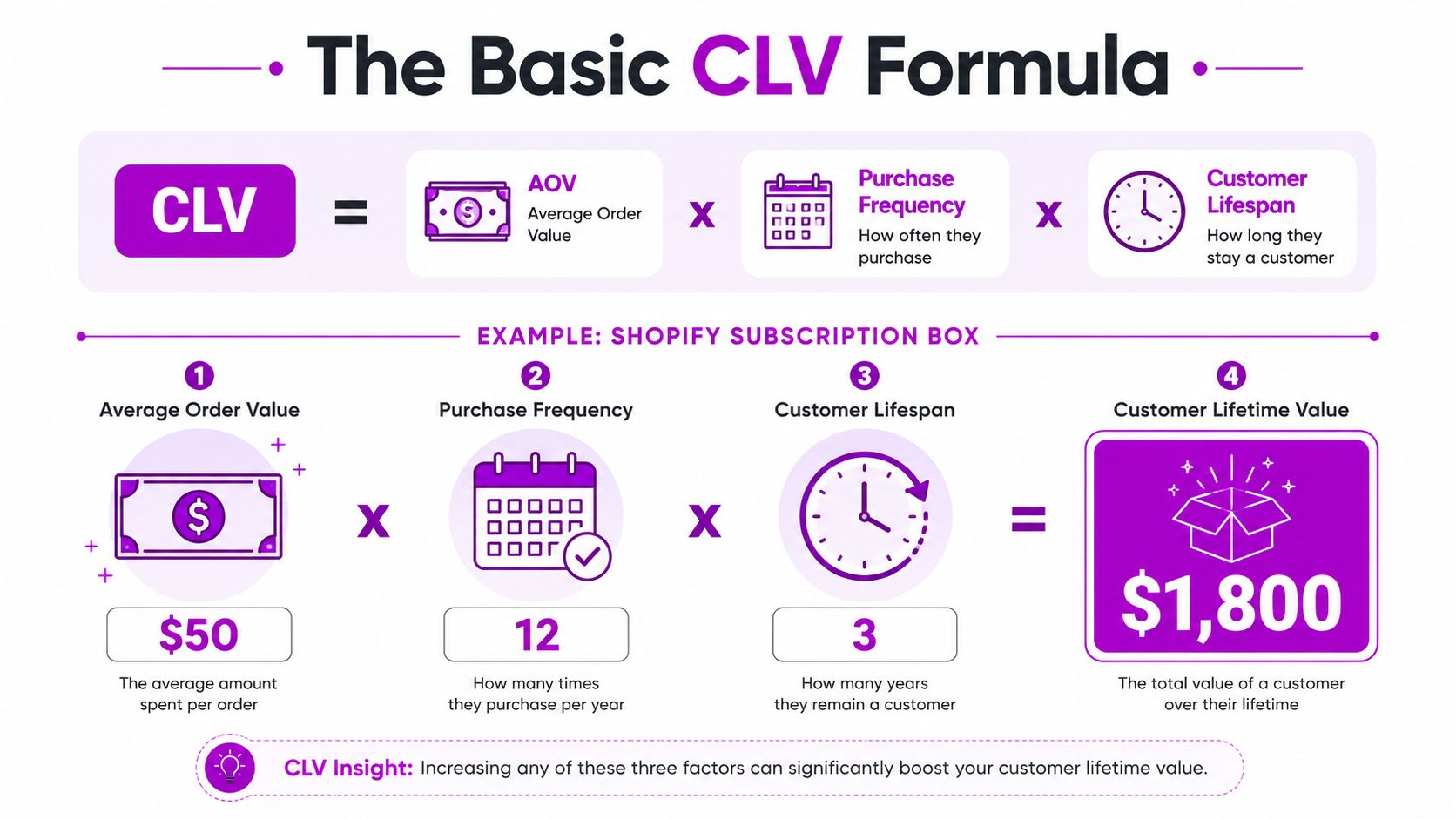
The standard formula is:
LTV = Average Order Value × Purchase Frequency × Average Customer Lifespan
But this simple version hides important nuance:
- Gross vs net LTV: gross LTV uses revenue; net LTV subtracts COGS, shipping, and payment processing to reflect actual profit contribution — the latter is far more useful for decision-making.
- Cohort-based LTV: calculating LTV for customers acquired in the same period reveals how value accrues over time, rather than blending customers at wildly different lifecycle stages into one number.
- Predictive vs historical LTV: historical LTV reports what’s already happened; predictive LTV models future value based on early behavior patterns, which is more useful for real-time acquisition decisions but requires enough data to model reliably.
The common mistake is calculating LTV once, early in a customer’s lifecycle, and treating it as fixed — when in reality LTV should be recalculated continuously as cohorts mature, since early-stage LTV projections are frequently wrong in either direction. A brand relying on a 90-day LTV estimate to make acquisition decisions is working with a fraction of the real picture if actual customer lifespan extends well beyond a year.
Why Does LTV:CAC Ratio Matter More Than LTV Alone?
A high LTV means very little without knowing what it cost to generate that value — which is why LTV:CAC ratio, not raw LTV, is the metric that actually determines whether acquisition spend is building a profitable business. The relationship works like this:
- LTV:CAC above 3:1 is a commonly cited healthy benchmark, indicating acquisition spend is generating durable, compounding returns.
- LTV:CAC near or below 1:1 signals the business is essentially buying revenue rather than building it, since acquisition costs are consuming most or all of the value a customer generates.
- Payback period — how long it takes to recover CAC from a customer’s margin contribution — matters independently of the ratio, since a business with tight cash flow can’t survive a 12-month payback period even if the eventual ratio looks strong on paper.
The assumption worth challenging: a high LTV doesn’t automatically mean a brand can afford aggressive acquisition spend. If CAC is rising in parallel with LTV, the ratio can stay flat or even worsen while both individual numbers look impressive in isolation. This is exactly why LTV should never be reported or evaluated without CAC sitting right next to it — a brand celebrating “LTV growth” while CAC quietly climbs at the same or faster rate isn’t actually improving its underlying profitability.
When Should You Be Concerned About a Low LTV?
A lower-than-average LTV isn’t automatically a crisis — but there are specific conditions where it signals a genuine threat to the business rather than just a category characteristic. You should be concerned when:
- LTV is declining across consecutive cohorts, even after controlling for seasonality and category-normal purchase cycles.
- CAC is flat or rising while LTV stagnates or falls, compressing the LTV:CAC ratio toward an unsustainable level.
- A large share of LTV depends on a small number of high-value outlier customers, meaning the “average” LTV number masks a fragile concentration risk.
- Repeat purchase rate is declining, since repeat purchases are typically the primary driver of LTV growth beyond the first transaction.
Conversely, a lower absolute LTV isn’t a problem on its own if it’s consistent with your product category’s natural purchase frequency and paired with a correspondingly low CAC that preserves a healthy ratio. The real signal isn’t the raw number — it’s whether LTV is trending in the right direction relative to acquisition cost, and whether the business is becoming more or less dependent on constant new customer acquisition to sustain revenue.
How Can Marketing Automation Increase Customer Lifetime Value?
Marketing automation is one of the most direct levers available for increasing LTV, because it acts on the two variables that compound value over time: purchase frequency and customer lifespan. The mechanisms that move LTV in practice:
- Post-purchase flows that educate customers and set product-use expectations, reducing the “buy once and disappear” pattern that caps LTV at a single transaction.
- Replenishment and reorder reminders, timed to actual usage cycles rather than arbitrary intervals, directly increasing purchase frequency.
- Win-back flows targeting customers before they fully lapse, extending the effective customer lifespan rather than letting it end silently.
- Loyalty and segmentation-based offers, reinforcing repeat behavior among your highest-value customers rather than treating every customer identically.
- Cross-sell and upsell sequencing, increasing average order value across the customer relationship, not just on the first transaction.
For WooCommerce brands, the effectiveness of these flows depends on how deeply purchase history and behavioral data are integrated into the CRM and automation platform — a generic, time-based email sequence will consistently underperform one triggered by actual product usage and purchase patterns. Brands that connect real order data to segmented, behavior-triggered automation see LTV grow because the messaging matches where the customer actually is in their lifecycle, not because of any single flow in isolation.
Ready to take your e-commerce to the next level?
If your LTV numbers look healthy on a dashboard but your retention efforts feel like they’re stalling revenue, or if you suspect your acquisition spend is quietly outpacing the value each new customer actually generates, the gap usually isn’t visible until LTV and CAC are examined together. A rising LTV means little if CAC is climbing just as fast underneath it.
This is exactly the kind of gap we help DTC and ecommerce brands close. As an extension of your in-house team, we build data-driven systems where tracking, consent, CRM, paid media, and automation work together to maximise LTV and long-term profitability — not just a benchmark figure that looks good in isolation. If you want an honest, cohort-level read on what’s actually driving or capping your customer lifetime value, book a free marketing automation audit and get a data-driven, conversion-focused view of the real picture.



Comments