


Every customer interacting with your store leaves a trail of signals — what they browse, what they click in an email, what they’ve bought before, whether they open your SMS messages — and most brands only use a fraction of that trail to inform how they market to that person. Behavioral targeting is what allows you to treat customers the way they actually want to be treated, using their real actions rather than broad demographic guesses to shape every message they receive. In this article, we’ll define behavioral targeting, contrast it with contextual targeting, walk through the workflow that makes it work in practice, and cover how to implement it ethically using consent-based data.
What Is Behavioral Targeting and How Does It Work?
Behavioral targeting personalizes marketing based on the full spectrum of a person’s actual actions — onsite behavior, email and SMS engagement, purchase history, and loyalty activity — rather than relying primarily on demographic assumptions about who that customer is.
What behavioral targeting draws on in practice:
- Onsite behavior: pages viewed, products browsed, search queries, cart activity, and time spent engaging with specific content or categories.
- Email and SMS engagement: opens, clicks, and response patterns across marketing communications, revealing which content and offers a customer actually engages with.
- Purchase history: what a customer has bought, how often, and at what value, forming the most concrete signal of actual preference and intent.
- Loyalty and account activity: repeat engagement patterns, account logins, and program participation that indicate depth of relationship with the brand.
The distinction that matters is treating these signals holistically rather than in isolated silos. A customer who browses a product category, opens related emails, but hasn’t purchased yet represents a fundamentally different targeting opportunity than one who’s already purchased from that category multiple times — and behavioral targeting is what allows marketing to respond to that difference with genuinely relevant messaging, rather than treating every customer in a broad segment identically regardless of where they actually sit in their relationship with the brand.
How Does Behavioral Targeting Differ From Contextual Targeting?
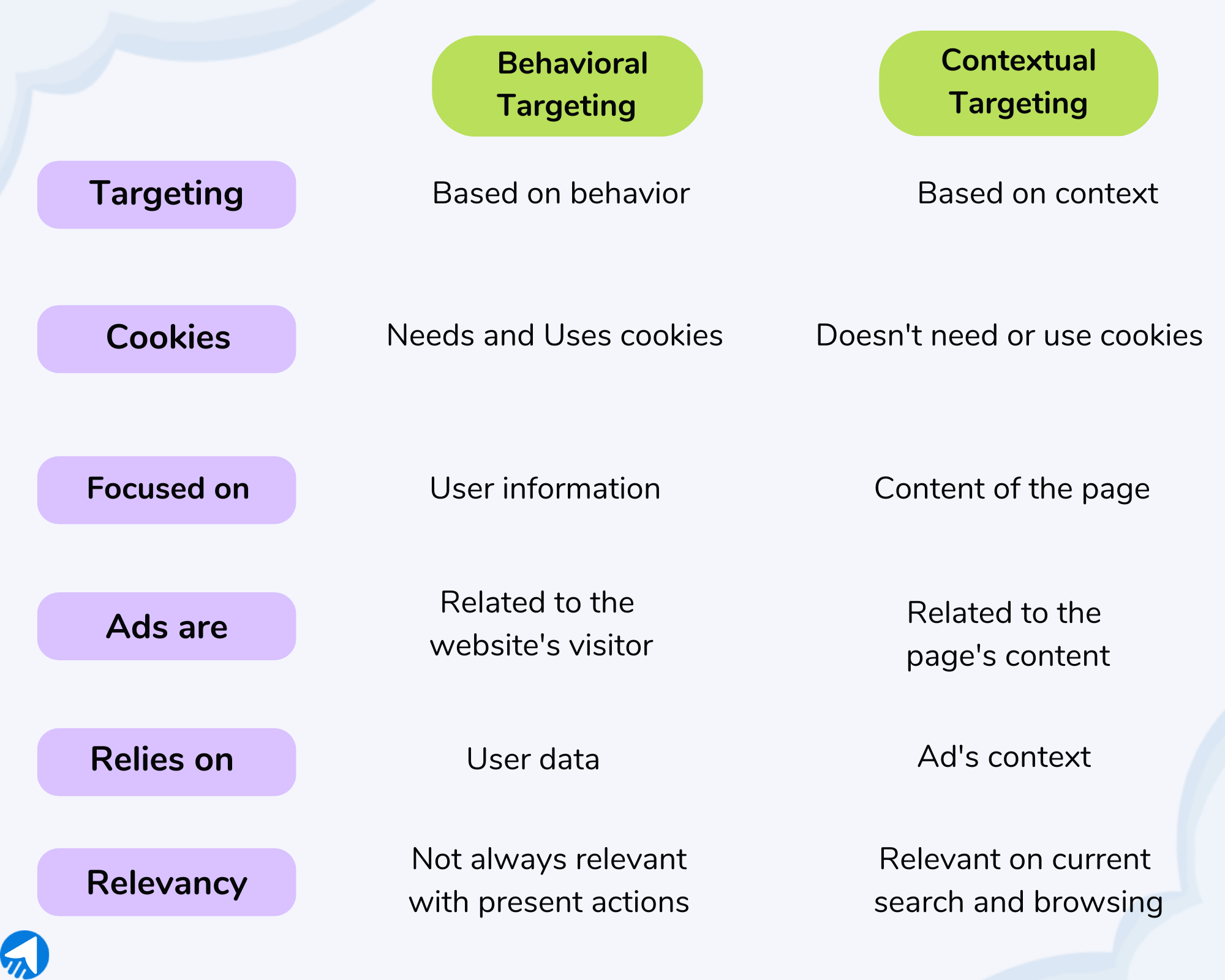
Behavioral and contextual targeting are often confused, but they operate on fundamentally different logic — one personalizes based on who the person is and what they’ve done, while the other matches messaging to the content or environment someone is currently viewing.
The core distinctions:
- Contextual targeting: matches ads or content to the page or environment a person is currently viewing (a running shoe ad on a fitness article, for instance), without relying on individual user data or history.
- Behavioral targeting: builds an individualized experience from actual user data and past behavior, regardless of what content or context the person is currently in, making it more precise but also more dependent on accurate first-party data.
- Privacy implications differ significantly: contextual targeting doesn’t require tracking individual behavior over time, making it inherently more privacy-friendly; behavioral targeting’s precision comes specifically from tracking and using individual behavioral data, which raises the privacy stakes considerably.
- Precision vs. scale tradeoff: behavioral targeting typically achieves higher relevance and conversion for known customers, while contextual targeting can reach broader, anonymous audiences without requiring individual identification.
The practical implication for ecommerce is that these approaches often work best in combination rather than as an either/or choice — contextual targeting can support top-of-funnel discovery and broader reach, while behavioral targeting drives the precision needed for lifecycle marketing, retention, and personalized offers to known customers. The privacy sensitivity of behavioral targeting specifically is why it requires a more deliberate, consent-conscious approach than contextual targeting typically demands.
Why Does Ethical Data Collection Matter for Behavioral Targeting?
Behavioral targeting’s effectiveness depends entirely on accurate customer data, but how that data is collected and used determines whether the resulting personalization builds trust or erodes it — a distinction that matters both ethically and practically for long-term customer relationships.
The ethical foundation that makes behavioral targeting sustainable:
- Zero- and first-party data as the foundation: data customers knowingly and directly provide (purchase history, stated preferences, explicit consent-based tracking) forms a far more ethical and increasingly necessary foundation than third-party data sourced without direct customer relationship.
- Explicit consent as a prerequisite, not an afterthought: ethical behavioral targeting requires customers to have knowingly consented to the tracking and data use involved, rather than relying on opaque or bundled consent mechanisms that obscure what’s actually being collected.
- Third-party data and opaque tracking carry real risk: reliance on data sourced without direct customer relationship or transparency increasingly risks both regulatory non-compliance and customer trust erosion, particularly as privacy regulations and consumer awareness both continue to increase.
- Transparency about data use as ongoing practice: customers who understand what data is collected and how it’s used tend to trust and engage more with personalized marketing than those who perceive tracking as invasive or unexplained.
The common mistake is treating ethical data collection as a compliance checkbox rather than a genuine trust-building practice. Behavioral targeting built on transparent, consent-based first-party data tends to perform better over time precisely because customers who trust how their data is used engage more openly with personalized marketing — the ethical approach and the effective approach are, in this case, largely the same approach, not competing priorities.
What Is the Three-Step Workflow for Effective Behavioral Targeting?
Effective behavioral targeting programs follow a consistent underlying workflow — collecting data into a unified view, segmenting based on specific behaviors, and triggering personalized messages — regardless of the specific channels or tools involved.
The three core steps:
- Collect behavioral data into a single customer view: unifying onsite behavior, email/SMS engagement, purchase history, and loyalty activity into one connected customer record, rather than leaving this data fragmented across disconnected systems where no single view of the customer exists.
- Segment audiences based on specific actions: building segments defined by actual behavior (browsed a category without purchasing, opened emails but hasn’t bought recently, purchased a specific product type) rather than static demographic criteria alone.
- Trigger personalized messages across channels: delivering relevant messaging through email, SMS, onsite forms, or push notifications, timed and tailored to the specific behavior that triggered the segment, rather than a delayed or generic follow-up disconnected from the original action.
The common failure point in this workflow is step one — many brands attempt sophisticated segmentation and triggering without first solving the unified customer view problem, resulting in behavioral targeting built on incomplete or fragmented data. A customer’s onsite browsing behavior sitting in one system, their email engagement in another, and their purchase history in WooCommerce itself, without a CRM or automation platform connecting all three, makes genuinely holistic behavioral targeting difficult regardless of how sophisticated the segmentation logic downstream is designed to be. The unified data foundation has to come first.
How Can You Implement Behavioral Targeting Without Feeling Invasive?
Behavioral targeting’s precision is exactly what makes it powerful, but that same precision can feel unsettling to customers if implemented without care — the line between “helpful personalization” and “Big Brother” is thinner than many marketers assume, and crossing it damages trust.
Best practices for keeping behavioral targeting respectful:
- Honor unsubscribes and consent preferences immediately and completely: a customer who opts out of tracking or communication should see that preference respected without delay or workaround, reinforcing that their stated boundaries genuinely matter.
- Be transparent about what data is used and why: clear, accessible privacy communication (not buried in dense legal text) helps customers understand and feel comfortable with how their behavior informs their experience.
- Focus on being genuinely helpful, not just persuasive: personalization that solves a real problem or anticipates a genuine need (a helpful reminder, a relevant recommendation) feels supportive; personalization that feels purely sales-driven or excessively frequent feels invasive, even when built on the same underlying data.
- Avoid over-personalization that reveals too much tracking: referencing behavior in a way that feels natural (a relevant product suggestion) differs meaningfully from referencing it in a way that makes the extent of tracking uncomfortably obvious (explicitly mentioning exact browsing timestamps, for instance).
- Lean on established best practices and expert guidance rather than pushing personalization tactics to their technical limit simply because the data allows it — just because a behavior can be tracked and acted upon doesn’t mean every possible use of that data serves the customer relationship well.
The distinction ultimately comes down to intent and execution: behavioral targeting implemented to genuinely serve the customer’s actual needs and interests, with clear consent and respected boundaries, builds a stronger long-term relationship than personalization implemented purely to maximize short-term conversion, even when both draw on identical underlying data.
Ready to take your e-commerce to the next level?
If your retention efforts feel like they’re stalling revenue, or if you suspect your current marketing treats every customer the same regardless of what they’ve actually done, behavioral targeting built on a genuinely unified customer view is often the missing infrastructure. Personalization based on real behavior — implemented transparently and with consent respected — consistently outperforms broad, demographic-based messaging, both in engagement and in the trust it builds over time.
This is exactly the kind of gap we help DTC and ecommerce brands close. As an extension of your in-house team, we build data-driven systems where tracking, consent, CRM, and marketing automation work together to power genuinely ethical, effective behavioral targeting — not just personalization tactics layered on top of fragmented data. If you want to see what a properly unified, consent-based behavioral targeting strategy could do for your engagement and retention, book a free marketing automation audit and get a data-driven, conversion-focused review of your current setup.



Comments