


Most ecommerce brands feed Meta and Google Ads a single “Purchase” event and assume that’s sufficient signal to acquire more customers — but a Purchase event doesn’t distinguish between a brand-new customer and someone on their fifth order, which means the algorithm is optimizing toward whichever is more common, not necessarily toward genuine new customer acquisition. If growth depends on winning first-time buyers specifically, platforms need a signal engineered to tell that difference. In this article, we’ll break down why generic purchase tracking fails to prioritize new customer acquisition, what “signal engineering” actually means in practice, and how to build a first-party data signal that gives Meta and Google Ads something genuinely worth optimizing for.
What Happens When You Only Track Purchases Instead of New Customers?
Tracking a single, undifferentiated Purchase event tells ad platforms that a conversion happened, but it tells them nothing about whether that conversion represents a new customer or an existing one reordering — a distinction that matters enormously if new customer acquisition is the actual campaign goal.
The consequence of this signal gap:
- Algorithms optimize toward whichever converts more easily: if repeat customers convert more readily than first-time buyers (which is common, since they already trust the brand), undifferentiated Purchase tracking can inadvertently train campaigns to find more people who resemble existing customers rather than genuinely new prospects.
- Retargeting and acquisition budgets blur together: without a way to distinguish new from repeat purchases in reporting, it becomes difficult to evaluate whether acquisition-focused campaigns are actually acquiring new customers or simply converting warm, already-familiar traffic.
- Lookalike audiences get built from the wrong seed data: a lookalike built from “all purchasers” includes a mix of new and repeat customers, diluting the audience model’s ability to specifically find prospects who resemble genuinely new, previously unacquired customers.
- Value-based bidding can’t prioritize acquisition value specifically: without differentiated signal, bidding algorithms can’t be instructed to prioritize the specific value of winning a new customer versus the value of a repeat transaction from an existing one.
The mistake most brands make is assuming that because purchases are being tracked accurately, the platforms have what they need to optimize for growth. In reality, a platform can only optimize toward what it’s told to distinguish — and “new customer” is a distinction that has to be deliberately engineered into the data being sent, not something Meta or Google can infer on their own from a generic conversion event.
What Does “Signal Engineering” Actually Mean for Ecommerce Ad Platforms?
Signal engineering refers to the deliberate design and structuring of the data sent to ad platforms so that it gives the optimization algorithm something specific and meaningful to work toward, rather than relying on default, undifferentiated event tracking.
The core principle behind signal engineering:
- Platforms optimize toward whatever signal they’re given: Meta and Google’s algorithms are powerful, but they can only prioritize distinctions that are explicitly present in the data feeding them — they can’t infer “this customer is new” from a standard Purchase event alone.
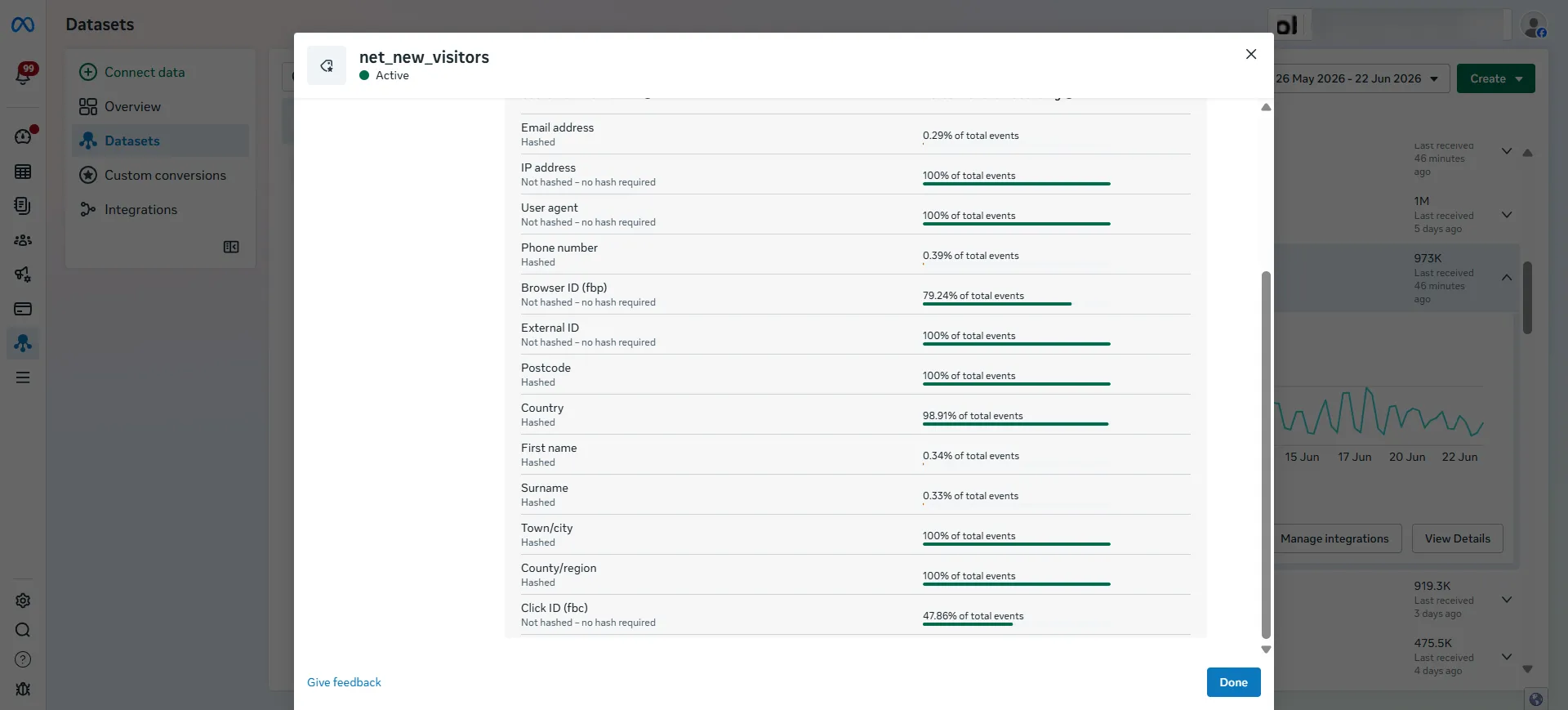
- Custom event parameters carry the distinction: signal engineering typically involves passing an additional parameter or custom event (flagging whether a purchase is a customer’s first order) alongside the standard conversion event, giving the platform genuine signal to optimize against.
- First-party data is the foundation: this distinction can only be made accurately using your own customer and order data — WooCommerce’s order history knows definitively whether a given order is a customer’s first, in a way that platform-side tracking alone cannot determine.
- Applies beyond new-customer flagging: the same principle extends to signaling order value, product category, or predicted LTV — any meaningful business distinction that would help the algorithm optimize toward better outcomes, not just more conversions.
The mistake to avoid is assuming that installing a standard Pixel or Conversions API integration automatically gives platforms sophisticated optimization signal. Default implementations typically pass a generic Purchase event with basic value data — genuinely useful signal engineering requires deliberately structuring what additional first-party data gets passed alongside that baseline, informed by what the business actually needs the algorithm to prioritize.
How Do You Identify a First-Time Buyer Using WooCommerce Order Data?
Accurately flagging a first-time buyer requires reliable logic built on WooCommerce’s actual order history, since getting this determination wrong (misclassifying repeat customers as new, or vice versa) undermines the entire signal engineering effort.
Practical approaches to first-time buyer identification:
- Order count-based logic: the most straightforward approach — checking whether the current order is the customer’s first completed order in WooCommerce’s order history, tied to their customer account or email address.
- Guest checkout consideration: since guest checkouts don’t automatically tie to a persistent customer account, identifying first-time buyers among guest orders requires matching by email address across order records, which needs to be handled carefully to avoid both false positives and false negatives.
- Timeframe definition: deciding whether “first-time buyer” means genuinely first-ever order, or first order within a defined lookback window (useful for accounts that have been dormant for a long period and may functionally behave like new customers again).
- Handling returns and cancellations: ensuring the first-time buyer determination is based on genuinely completed orders, not orders that were later cancelled or fully refunded, which shouldn’t count toward establishing “existing customer” status.
The common technical pitfall is building this logic on the fly at checkout without accounting for edge cases like guest checkout email matching or refunded first orders — an inaccurate first-time buyer flag is arguably worse than no flag at all, since it actively misleads the ad platform’s optimization rather than simply leaving it under-informed. This logic needs to be built carefully against actual, clean order history data, ideally as a maintained piece of infrastructure rather than a one-off script.
How Do You Pass the First-Time Buyer Signal Into Meta and Google Ads?
Once first-time buyer status is accurately determined from WooCommerce order data, it needs to be passed into Meta and Google’s conversion tracking systems in a way both platforms can actually use for optimization.
The technical implementation approach:
- Custom conversion events for Meta: rather than relying solely on the standard “Purchase” event, passing a custom event (or a custom parameter on the standard event) specifically flagging first-time buyer status, ideally through the Conversions API for reliability.
- Enhanced conversions or custom parameters for Google Ads: similarly, structuring conversion tracking to include a first-time buyer flag, allowing campaigns and bidding strategies to be built around this specific signal.
- Separate conversion actions for new vs. repeat purchases: on both platforms, some advertisers structure entirely separate conversion actions for first-time versus repeat purchases, allowing campaign-level optimization to target new customer acquisition specifically, rather than blending both into one undifferentiated goal.
- Value-based bidding weighted toward new customer acquisition: once the signal is flowing, value-based bidding can be configured to weight new customer conversions more heavily, directly aligning campaign optimization with the actual acquisition goal rather than overall conversion volume.
The implementation depends fundamentally on reliable server-side tracking (Conversions API for Meta, Enhanced Conversions for Google), since this level of custom parameter passing typically requires more than basic client-side pixel tracking can reliably deliver. For WooCommerce stores, this means the first-time buyer determination made at the order-processing level needs to flow directly into the server-side tracking implementation, rather than being calculated separately or inconsistently across different parts of the tracking stack.
Why Does This Level of Signal Engineering Meaningfully Improve Acquisition Campaign Performance?
Properly engineered first-time buyer signal doesn’t just improve reporting clarity — it directly changes what the algorithm optimizes toward, which tends to produce measurably better new-customer acquisition performance than undifferentiated tracking.
The performance mechanisms at play:
- More accurate campaign attribution: separating new customer conversions from repeat ones reveals which campaigns and audiences are genuinely driving acquisition, versus which are largely converting already-warm, existing customers.
- Better-informed lookalike audiences: building lookalikes specifically from verified first-time buyers, rather than all purchasers, produces a seed audience that more accurately represents the profile of a genuinely new customer worth replicating.
- Value-based bidding that reflects real acquisition priorities: if new customer acquisition carries strategic value beyond the immediate transaction (which it typically does, given LTV potential), value-based bidding weighted toward this signal directs budget more efficiently toward the outcome that actually matters.
- Clearer separation between acquisition and retention budget effectiveness: distinguishing new from repeat purchases in reporting allows more honest evaluation of whether acquisition-labeled campaigns are actually acquiring, or whether retention-oriented tactics deserve more credit and budget than they’re currently receiving.
The broader principle worth internalizing is that ad platforms are only as strategic as the data they’re given. A brand that engineers meaningful, business-specific signal into its tracking — first-time buyer status being one clear, high-value example — gives Meta and Google something genuinely worth optimizing toward, rather than leaving the algorithm to infer priorities from generic, undifferentiated conversion data that treats every purchase as equally valuable regardless of what it actually represents for the business.
Ready to take your e-commerce to the next level?
If your acquisition campaigns are technically converting but you suspect a meaningful share of that “success” is actually existing customers reordering rather than genuinely new buyers, the platforms aren’t being given what they need to tell the difference — and no amount of creative or targeting optimization fixes a signal problem at the data layer. This is exactly the kind of gap that quietly caps acquisition campaign performance while looking fine on the surface.
This is exactly the kind of gap we help DTC and ecommerce brands close. As an extension of your in-house team, we build data-driven systems where advanced tracking, first-party data, and paid media on Meta and Google Ads work together — engineering the specific signals your campaigns actually need to optimize toward real acquisition, not just conversion volume. If you want to see what properly engineered first-party signal could do for your new customer acquisition performance, book a free marketing automation audit and get a data-driven, conversion-focused view of your current tracking setup.


Comments