


Sending the same email to your entire list is one of the fastest ways to plateau email performance — open rates decline, unsubscribes creep up, and revenue per send quietly stagnates even as list size grows. Email list segmentation solves this by grouping subscribers based on behavior, purchase history, and lifecycle stage, so every campaign lands with the right message at the right moment. In this article, we’ll walk through the segmentation criteria that actually move performance — behavioral, RFM, and lifecycle-based — and show how WooCommerce data makes precise segmentation possible without relying on broad, generic email blasts.
What Is Email List Segmentation and Why Does It Matter?
Email list segmentation is the practice of dividing subscribers into smaller groups based on shared characteristics — behavior, purchase history, engagement level, or lifecycle stage — so campaigns can be tailored to what’s actually relevant to each group, rather than broadcast identically to everyone.
The performance case for segmentation is substantial:
- Higher open and click-through rates, since subject lines and content match what the recipient actually cares about rather than a generic message.
- Lower unsubscribe and spam complaint rates, because irrelevant content is the primary driver of list fatigue.
- Better deliverability over time, since inbox providers weight engagement signals heavily — segmented, relevant campaigns generate the positive engagement that protects sender reputation.
- Higher revenue per email, because offers and messaging align with where the customer actually is in their purchase journey.
The mistake most ecommerce brands make is treating their list as one audience with minor personalization (first name in the subject line) rather than genuinely different audiences with different needs. A first-time buyer, a lapsing customer, and a VIP repeat purchaser require fundamentally different messaging, not the same campaign with a different merge tag. For WooCommerce stores, the raw material for meaningful segmentation already exists in order data, purchase history, and browsing behavior — the gap is usually in connecting that data to the email platform in a way that supports dynamic, rule-based segmentation rather than manual list exports.
How Do You Segment by Behavior and Engagement?
Behavioral segmentation groups subscribers by what they’ve actually done — opens, clicks, site visits, cart activity — rather than static demographic data, and it’s typically the highest-leverage segmentation type for ecommerce because it reflects real purchase intent. Common behavioral segments worth building:
- Engaged vs disengaged subscribers: separating recent openers/clickers from those who haven’t interacted in 60-90+ days, since sending identical campaigns to both groups drags down overall deliverability metrics.
- Cart abandoners: visitors who added items but didn’t complete checkout, ideal for targeted recovery flows rather than generic promotional content.
- Browse abandoners: subscribers who viewed specific products or categories without adding to cart, useful for lighter-touch, interest-based follow-up.
- Website engagement without purchase: subscribers actively visiting the site but not converting, which may signal a pricing, trust, or friction issue worth addressing directly.
- Email engagement tiers: segmenting by open/click frequency to protect sender reputation by suppressing consistently unengaged addresses from regular sends.
The key advantage of behavioral segmentation is that it reflects current intent rather than historical assumption — a customer who browsed a product yesterday is a fundamentally more relevant target for that product’s follow-up than someone bucketed purely by demographic or purchase-date data. Behavioral segments require real-time or near-real-time data flow from the storefront into the email platform, which is where a properly connected WooCommerce integration becomes essential rather than optional.
What Is RFM Segmentation and How Does It Apply to Ecommerce?
RFM segmentation groups customers by three purchase-based dimensions — Recency, Frequency, and Monetary value — and it’s one of the most reliable frameworks for ecommerce because it’s built entirely on actual transaction data rather than inferred behavior. The three dimensions:
- Recency: how recently a customer made a purchase — recent buyers are typically more receptive to further engagement than lapsed ones.
- Frequency: how often a customer purchases — frequent buyers represent your most reliable revenue base and often respond well to loyalty-oriented messaging.
- Monetary value: how much a customer has spent — high spenders warrant different treatment (VIP offers, early access) than low-spend, infrequent buyers.
Combining these three dimensions produces useful customer segments such as:
- Champions (high recency, high frequency, high monetary) — your best customers, best served with loyalty and early-access messaging rather than discounts they don’t need.
- At-risk (high frequency/monetary historically, but declining recency) — a critical win-back segment before they fully churn.
- New customers (high recency, low frequency) — ideal candidates for onboarding and second-purchase incentive flows.
- Low-value, infrequent — often best served with lighter-touch, lower-cost campaigns rather than the same investment as high-value segments.
The strategic value of RFM is that it directs marketing effort proportionally — treating a Champion and a low-value lapsed customer identically wastes budget on one and under-invests in the other. For WooCommerce stores, RFM scoring depends on clean, accessible order history data, which is why it works best when purchase data flows directly into the CRM or email platform rather than being calculated manually on an irregular basis.
Why Should You Segment by Customer Lifecycle Stage?
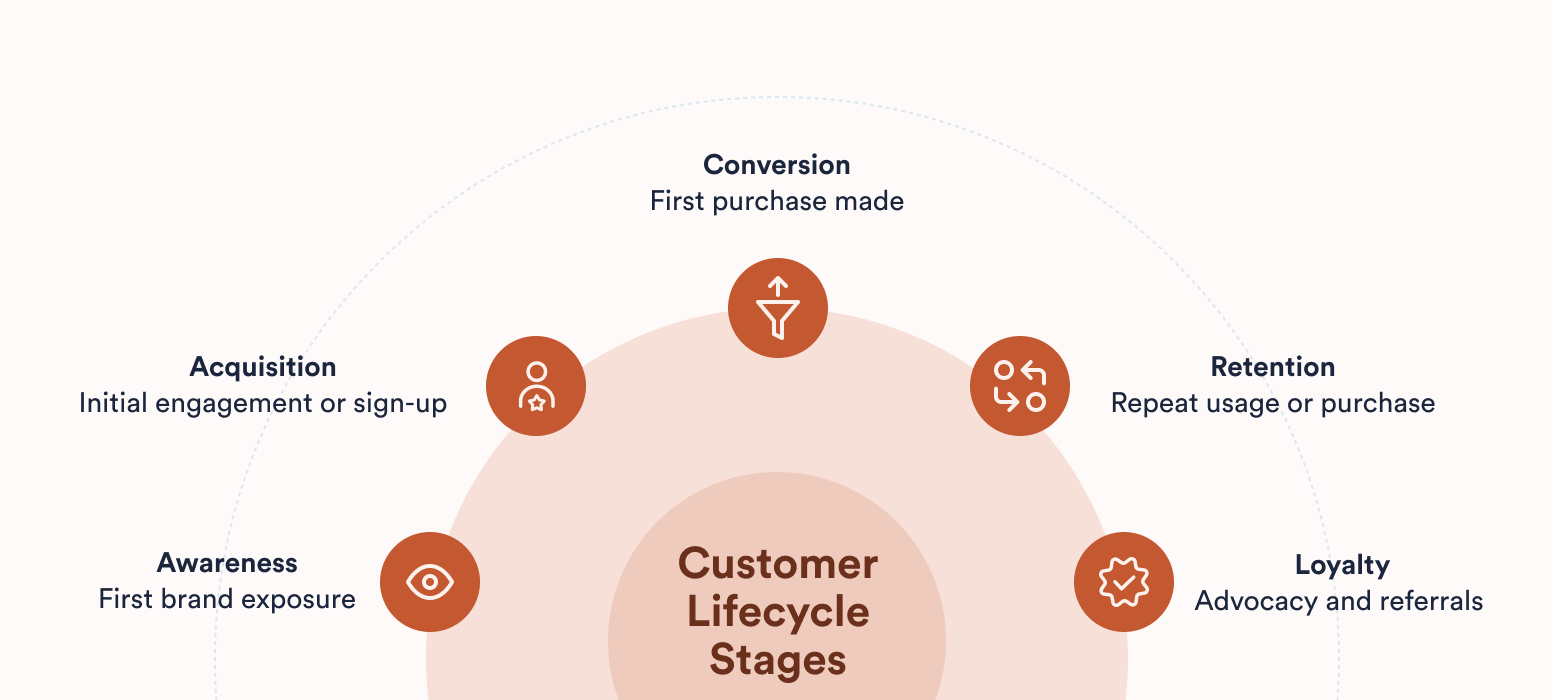
Lifecycle segmentation groups subscribers by where they sit in their relationship with the brand — prospect, new customer, repeat customer, at-risk, or lapsed — and it matters because the right message changes fundamentally at each stage. The core lifecycle stages and what they need:
- Prospects/subscribers who haven’t purchased: nurture content and first-purchase incentives, focused on building trust and reducing first-order friction.
- New customers (first purchase): onboarding content, product education, and second-purchase incentives, since the highest-risk churn point is often right after the first order.
- Repeat customers: loyalty reinforcement, cross-sell and upsell offers based on purchase history, rather than generic acquisition-style messaging.
- At-risk customers: win-back campaigns timed to typical repurchase windows, before the customer fully lapses.
- Lapsed customers: re-engagement campaigns with a clear, compelling reason to return, or eventual suppression to protect deliverability if consistently unresponsive.
The common mistake is applying the same cadence and content across all stages, particularly sending aggressive acquisition-style discounting to customers who are already loyal repeat buyers — which trains your best customers to wait for discounts rather than purchase at full price. Lifecycle segmentation requires an accurate, continuously updated view of where each customer actually sits, which depends on order data flowing into the email platform in near real time rather than a static list updated periodically.
How Can You Automate Segmentation in a WooCommerce Store?
Manually updating segments based on order data and behavior is unsustainable past a small list — automation is what makes behavioral, RFM, and lifecycle segmentation dynamic rather than a snapshot that goes stale within days.
Effective automated segmentation typically includes:
- Direct WooCommerce-to-CRM data sync, so order history, product categories, and purchase frequency update segments automatically as new orders come in.
- Dynamic, rule-based segments that recalculate continuously (e.g., a customer automatically moves from “new customer” to “repeat customer” segment upon their second order) rather than requiring manual re-tagging.
- Behavioral triggers layered on top of static segments, so a “repeat customer” who abandons a cart still receives a targeted recovery flow rather than falling into a generic recurring newsletter.
- RFM scoring automation, recalculating recency, frequency, and monetary scores on a schedule so segments reflect current purchase behavior, not a snapshot from months ago.
The brands that get the most from segmentation treat it as living infrastructure connected to real order data, not a one-time list-cleaning exercise — because customer behavior shifts continuously, and static segments degrade in relevance the longer they go unmaintained.
Ready to take your e-commerce to the next level?
If your email campaigns feel like they’re underperforming despite a healthy list size, or if you suspect you’re sending the same message to customers who need completely different things from your brand, the fix usually isn’t a better subject line — it’s the segmentation feeding the campaign in the first place. A broad, unsegmented list will always underperform, no matter how polished the creative is on top of it.
This is exactly the kind of gap we help DTC and ecommerce brands close. As an extension of your in-house team, we build data-driven systems where tracking, consent, CRM, and marketing automation work together to maximise LTV and long-term growth — including the behavioral and RFM segmentation that actually drives email performance. If you want to see what precise, WooCommerce-connected segmentation could do for your campaign revenue, book a free marketing automation audit and get a data-driven, conversion-focused review of your current setup.

Comments