

Most win-back emails follow the same tired formula — “we miss you” paired with a generic 10% off code — and most of them get ignored, because they arrive without any real understanding of why the customer stopped engaging in the first place. A win-back flow that actually works requires precise segmentation, timing calibrated to the customer’s own purchase cycle, and an offer structure that addresses the real reason for disengagement rather than assuming discount is the only lever available. In this article, we’ll walk through how to build a win-back email flow that genuinely re-engages lapsing customers, covering segmentation, timing, and offer design for WooCommerce brands.
What Makes a Win-Back Flow Different From a Generic Re-Engagement Campaign?
A win-back flow is a targeted, automated sequence aimed specifically at customers showing clear signs of lapsing, as opposed to a broad re-engagement campaign sent to an entire inactive segment without differentiation.
The key distinctions:
- Precision targeting: a true win-back flow triggers based on a customer’s individual purchase cycle and engagement pattern, not a blanket “hasn’t purchased in 90 days” rule applied uniformly across a diverse customer base.
- Sequenced, multi-touch structure: rather than a single email, an effective win-back flow typically involves a short sequence — each message serving a different purpose (reminder, value reinforcement, incentive) rather than repeating the same message.
- Behavioral context awareness: a well-built flow accounts for what the customer actually purchased and how they previously engaged, rather than treating all lapsing customers identically regardless of purchase history.
- Clear exit criteria: the flow should stop (or shift to suppression) once a customer re-engages, rather than continuing to send win-back messaging to someone who already returned.
The common mistake is treating “win-back” as a single generic email fired at anyone who hasn’t purchased recently, regardless of what they bought, how often they typically purchase, or why they might have gone quiet. A customer whose typical repurchase cycle is 45 days going silent for 60 days needs a fundamentally different message than someone who bought a one-time furniture item eight months ago — conflating the two into the same flow wastes the opportunity that precise segmentation would otherwise capture.
How Should You Segment Customers for a Win-Back Flow?
Effective win-back segmentation starts with recognizing that “lapsed” means something different for every customer, depending on their individual purchase frequency and product category — a single fixed inactivity window applied to everyone will always misfire for a meaningful share of the list.
Practical segmentation approaches:
- Relative recency, not absolute time: segment based on how far past a customer’s own typical repurchase window they’ve gone, rather than a flat “90 days since last purchase” rule applied to the entire list.
- Purchase category: consumable and subscription-adjacent buyers warrant different win-back timing and messaging than one-time, high-consideration purchasers, since their natural repurchase cycles differ enormously.
- Historical value tier: a previously high-spending, frequent customer going quiet deserves a different (often more personalized, less discount-reliant) approach than a low-value, single-purchase customer.
- Engagement history alongside purchase history: a customer who’s still opening emails but not purchasing needs a different message than one who’s disengaged from email entirely, since the underlying barrier is likely different.
The mistake most brands make is segmenting win-back flows purely by time elapsed since last purchase, ignoring frequency and category entirely. A customer who typically buys every 30 days and hasn’t purchased in 45 is genuinely at-risk and worth a timely win-back touch; a customer who buys a considered, one-time product every 12-18 months isn’t “lapsed” at 45 days at all — sending them a win-back email that early reads as tone-deaf rather than attentive, precisely because the segmentation didn’t account for their actual purchase pattern.
When Should a Win-Back Email Actually Be Sent?
Timing is arguably the single most important variable in win-back flow performance — sending too early treats an engaged customer as lapsed, while sending too late means re-engagement becomes significantly harder than timely retention would have been.
Principles for getting timing right:
- Trigger relative to the customer’s own repurchase pattern, not a fixed calendar-based rule — a win-back flow should fire when a customer meaningfully exceeds their typical time-between-purchases, however long or short that individually is.
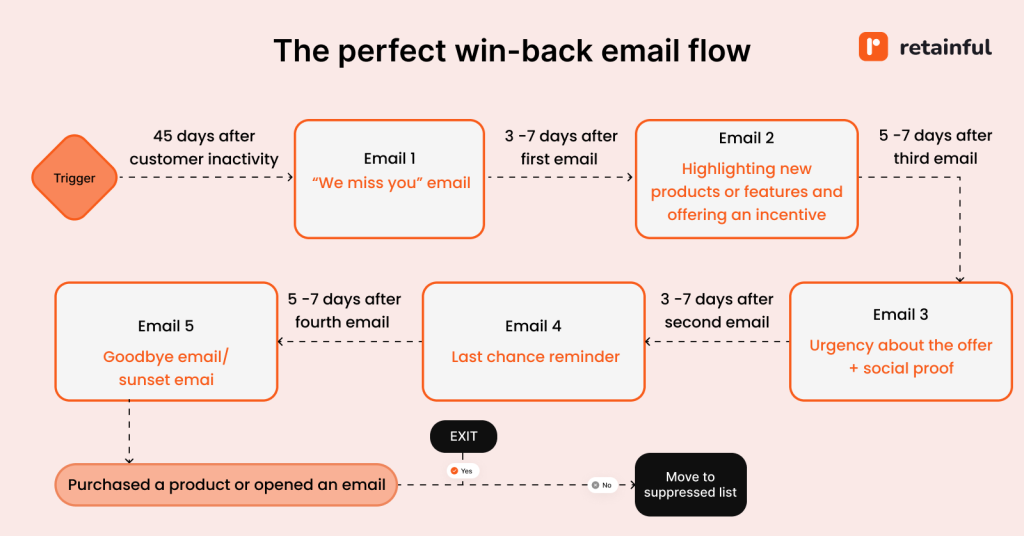
- Sequence multiple touches with increasing urgency, rather than a single email — an initial soft check-in, followed by value reinforcement, followed by a stronger incentive if earlier touches don’t prompt re-engagement.
- Account for product category differences, since a consumable that typically gets reordered every 30 days warrants much earlier win-back timing than a durable good with a naturally longer purchase cycle.
- Stop before the customer is genuinely gone, since data typically shows re-engagement odds decline substantially the longer a customer stays inactive — waiting too long to trigger the flow at all significantly reduces its effectiveness.
The common mistake is applying the same fixed day-count trigger (commonly 60 or 90 days) across an entire customer base regardless of product category or individual purchase history. This guarantees the flow fires too early for some customers and too late for others, missing the window where re-engagement is actually most likely to succeed. Automation that calculates timing relative to each customer’s own behavior consistently outperforms a flat, calendar-based trigger.
What Offer Structure Actually Re-Engages Lapsing Customers?
The instinct to lead every win-back email with a discount is understandable but often counterproductive — jumping straight to a steep percentage-off code signals that the brand’s only lever is price, which can train customers to wait for discounts rather than genuinely re-engage with the brand.
A more effective offer progression:
- First touch — value reminder, no discount: reinforce what the customer valued about the brand or product, potentially highlighting new products, content, or updates they may have missed, without leading with a price incentive.
- Second touch — light incentive or removed friction: a modest incentive (free shipping, a small percentage off) or addressing a likely barrier (highlighting an easy returns policy, answering a common hesitation) rather than an aggressive discount.
- Final touch — stronger incentive with clear urgency, reserved for customers who haven’t responded to the earlier, lower-pressure touches — this is where a more substantial offer makes sense, since it’s targeted only at genuinely at-risk customers rather than the entire segment.
- Category-appropriate incentive type: a percentage discount doesn’t fit every situation — for consumables, a replenishment reminder framed around convenience often outperforms a discount-led message; for considered purchases, addressing a likely objection may matter more than price.
The assumption worth challenging is that discount depth is the primary lever for re-engagement. In many cases, the real barrier isn’t price at all — it’s that the customer simply forgot about the brand, had a fulfillment issue that went unaddressed, or never fully understood the product’s ongoing value. Leading with discount assumes price is the obstacle without diagnosing whether that’s actually true, and it trains your most price-sensitive segment to wait for the next win-back email rather than purchasing at full price.
How Can WooCommerce Automation Make Win-Back Flows More Precise?
Manually managing win-back timing and segmentation across a growing customer base is unsustainable — automation is what makes relative-recency triggers, category-specific timing, and behavior-based segmentation actually feasible at scale.
What a properly automated win-back setup typically includes:
- Dynamic trigger calculation based on each customer’s individual purchase history, automatically identifying when they’ve meaningfully exceeded their own typical repurchase window rather than relying on a fixed day-count rule.
- Category-aware segmentation, so consumable buyers and one-time purchasers are automatically routed into appropriately timed and messaged flows rather than a single generic sequence.
- Automatic flow exit on re-engagement, ensuring a customer who returns mid-flow stops receiving win-back messaging and moves back into standard lifecycle communication.
- Engagement-tier-aware offer sequencing, adjusting the offer progression based on whether the customer is still opening emails or has gone fully dark, since these require different re-engagement strategies.
For WooCommerce stores, this level of precision depends on purchase history and product category data flowing directly into the CRM and automation platform — a generic, time-based win-back sequence disconnected from real order data will always underperform one that adapts to each customer’s actual behavior. Brands that build this properly see meaningfully higher re-engagement rates than those running a single static win-back email applied uniformly across the entire lapsed segment.
Ready to take your e-commerce to the next level?
If your retention efforts feel like they’re stalling revenue, or if you suspect your win-back emails are training customers to wait for discounts rather than actually bringing them back, the fix usually isn’t a deeper discount code — it’s the segmentation and timing feeding the flow in the first place. A win-back email sent at the wrong moment, to the wrong segment, rarely works regardless of how good the offer is.
This is exactly the kind of gap we help DTC and ecommerce brands close. As an extension of your in-house team, we build data-driven systems where tracking, consent, CRM, and marketing automation work together to maximise retention and LTV — including the precisely segmented, behavior-triggered win-back flows that actually bring lapsing customers back. If you want to see what a properly built win-back strategy could do for your re-engagement rate, book a free marketing automation audit and get a data-driven, conversion-focused review of your current setup.

Comments