


Here’s a question worth sitting with: is it easier to find a brand-new customer, or to get someone already in your checkout to add one more item to their cart? For nearly every ecommerce brand, the second option is dramatically cheaper and faster to execute — and yet most stores pour disproportionate effort into acquisition while leaving average order value (AOV) largely unoptimized. In this article, we’ll walk through actionable, practical tactics for increasing average order value, why AOV often delivers better ROI than acquisition spend, and how WooCommerce automation makes these tactics scalable rather than manual, one-off efforts.
What Is Average Order Value and Why Should You Prioritize Improving It?
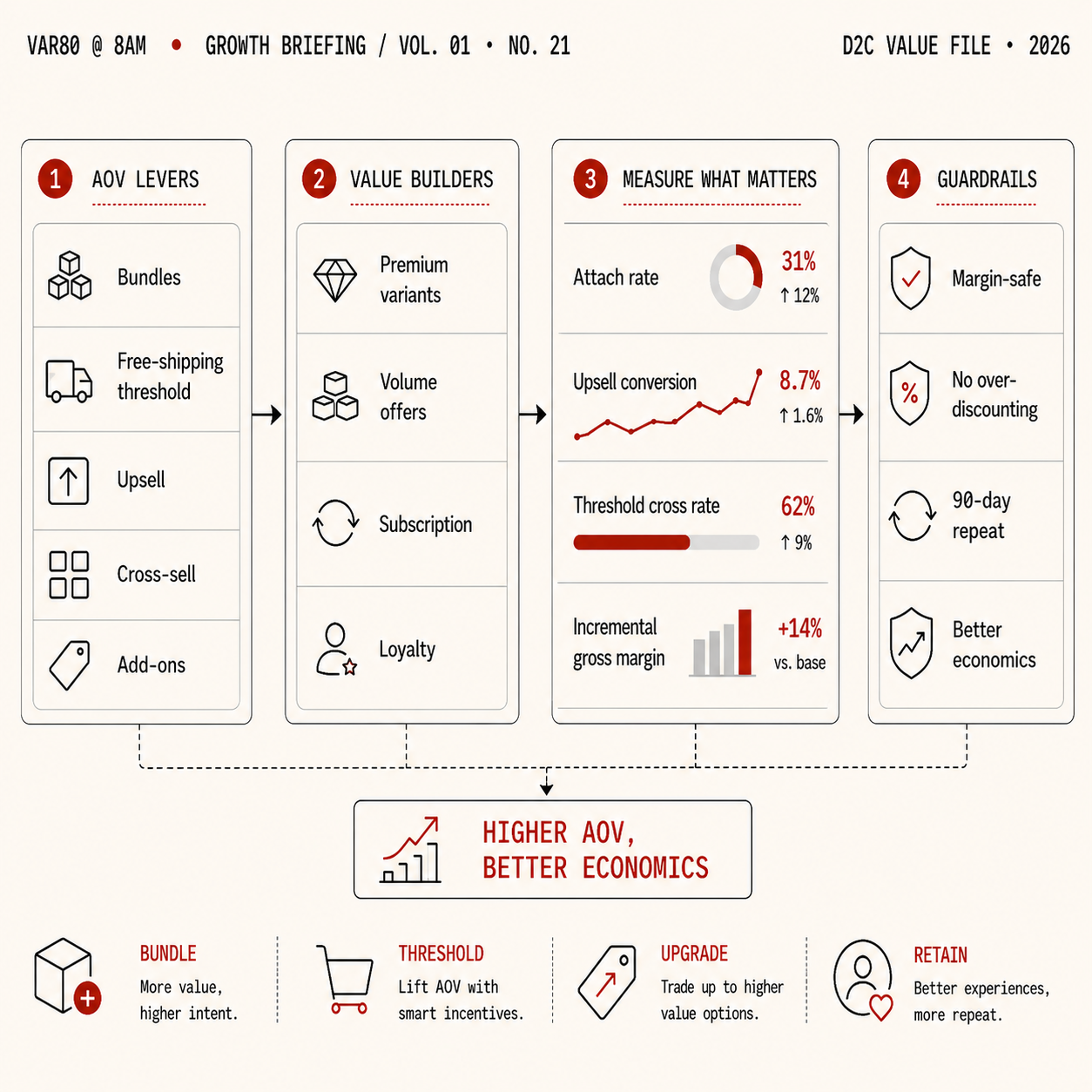
Average order value (AOV) is the average amount a customer spends per transaction, calculated by dividing total revenue by number of orders over a given period — and it’s one of the highest-leverage, lowest-cost levers available for increasing revenue without touching acquisition spend at all.
Why AOV deserves more attention than it typically gets:
- Zero incremental acquisition cost: increasing AOV means extracting more revenue from traffic and customers you’ve already paid to acquire, rather than spending more to bring in additional new customers.
- Directly improves unit economics: a higher AOV improves your LTV:CAC ratio without changing CAC at all, since the same acquisition cost now generates more revenue per transaction.
- Compounds with existing traffic: unlike acquisition tactics that require ongoing spend to sustain results, AOV improvements (once implemented) continue delivering value on every future transaction without additional cost.
- Often easier to test and iterate: on-site and checkout-level AOV tactics can typically be tested and refined faster than acquisition campaigns, which depend on external platform algorithms and audience dynamics outside your direct control.
The assumption worth challenging is that growth primarily comes from finding more customers. In reality, for many ecommerce brands, the fastest and most cost-effective path to meaningful revenue growth is getting existing traffic and customers to spend more per transaction — a lever that’s entirely within the brand’s control, unlike acquisition performance, which depends heavily on external platform costs and competition. AOV improvement deserves to be treated as a primary growth lever, not an afterthought bolted onto acquisition-focused strategy.
How Can Cross-Sell and Upsell Offers Increase Average Order Value?
Cross-sell and upsell offers are among the most direct AOV levers available, but their effectiveness depends heavily on timing, relevance, and placement — a poorly executed offer can suppress conversion rather than lift AOV.
Practical implementation approaches:
- Product page upsells: presenting a better version or upgraded tier while the customer is still deciding, ideal for considered purchases where a meaningful value upgrade is easy to articulate.
- Checkout-stage cross-sells: low-cost, highly relevant add-ons presented at the point of purchase, working best when the additional item requires minimal extra decision-making (an accessory, a refill, a companion item).
- Post-purchase cross-sell offers: presented immediately after checkout completion (before the customer leaves the confirmation page) or via follow-up email, ideal for higher-consideration complementary products.
- Bundle and kit offers: packaging complementary products together at a modest discount compared to buying separately, which can increase AOV while still feeling like genuine value to the customer.
The key principle across all of these tactics is relevance over price — a highly relevant, moderately priced add-on consistently outperforms an expensive but only tangentially related upsell, because the goal is reducing friction on a purchase the customer would likely make anyway, not introducing an entirely new decision. For WooCommerce stores, native cross-sell and upsell product relationships provide a baseline, but layering in behavioral and purchase history data through a connected CRM significantly improves relevance and, consequently, conversion on these offers.
Why Does a Free Shipping Threshold Work So Well for Increasing AOV?
A free shipping threshold — offering free shipping once a customer’s cart reaches a specific dollar amount — is one of the most consistently effective AOV tactics in ecommerce, because it directly and transparently incentivizes customers to add more to their cart.
Why this tactic performs so reliably:
- Directly visible, immediate incentive: unlike more subtle personalization-based tactics, a free shipping threshold gives customers a clear, calculable reason to add one more item (“add $12 more to qualify for free shipping”).
- Addresses a known purchase friction point: shipping cost is consistently cited as a leading cause of cart abandonment, so a free shipping incentive simultaneously reduces abandonment risk and increases order value.
- Threshold calibration matters significantly: setting the threshold too close to current average order value produces minimal AOV lift, while setting it meaningfully above current AOV (but still achievable) creates a genuine incentive to add items rather than abandon the cart.
- Works well paired with cross-sell suggestions: showing customers exactly which low-cost, relevant items would help them reach the threshold combines two AOV tactics into one cohesive, higher-converting experience.
The common mistake is setting a free shipping threshold without testing and calibrating it against actual AOV data, or failing to make progress toward the threshold visible to the customer during their shopping session. A threshold that’s invisible until checkout, or poorly calibrated relative to typical cart value, captures far less of the potential AOV lift than one that’s clearly communicated and strategically set just above current average spending patterns.
How Do Volume Discounts and Bundles Increase Average Order Value?
Volume discounts and bundling incentivize customers to purchase more units or more items per transaction by making the per-unit or combined price more attractive than buying individually — a tactic particularly effective for consumable or complementary products.
Common structures worth considering:
- Tiered volume discounts (“buy 2, save 10%; buy 3, save 15%”), which work particularly well for consumable products customers will eventually need to reorder anyway, effectively pulling forward future purchases into a single, larger transaction.
- Curated product bundles, packaging complementary items together (a skincare routine, a starter kit) at a combined price that’s attractive relative to buying each item separately, while still improving overall order value and margin mix.
- Mix-and-match bundle pricing, allowing customers to select from a curated set of products to build their own bundle at a bundle-level discount, balancing personalization with the AOV benefits of bundling.
- Subscription or auto-replenishment bundles, which increase not just single-order AOV but long-term customer value by establishing a recurring purchase pattern from the outset.
The strategic consideration worth keeping in mind is that volume discounts and bundles need to be calibrated carefully against margin — a poorly priced bundle can increase AOV while actually reducing overall profitability if the discount eats too deeply into margin. The goal is structuring these offers so the increased volume and order value more than compensates for the reduced per-unit margin, which requires genuine analysis of unit economics rather than an arbitrary discount percentage chosen without testing against actual cost structure.
How Can Marketing Automation Make AOV Tactics More Effective?
Manually managing cross-sell offers, free shipping progress indicators, and bundle recommendations across an entire catalog is unsustainable past a small store — automation is what makes these AOV tactics personalized and consistently applied rather than generic and static.
Automation levers that meaningfully improve AOV tactic performance:
- Behavior-triggered cross-sell recommendations, based on what’s actually in the cart or what a customer has previously purchased, rather than static, manually configured product relationships.
- Dynamic free shipping threshold messaging, showing personalized progress toward the threshold based on actual cart contents in real time.
- Segmented bundle and volume discount promotion, surfacing the most relevant bundle or discount tier to each customer based on their browsing and purchase history, rather than showing identical offers to everyone.
- Post-purchase AOV follow-up, using email or SMS to suggest complementary products calibrated to what was actually purchased, extending the AOV opportunity beyond the single checkout session.
- A/B testing infrastructure, allowing systematic testing of threshold levels, bundle pricing, and offer placement rather than relying on a single, never-revisited configuration.
For WooCommerce stores, the effectiveness of these tactics depends heavily on how well purchase history, cart behavior, and customer segments connect to the platform delivering these offers — a generic, one-size-fits-all approach to cross-sell and bundling will always underperform a connected system that adapts offers to actual customer behavior and purchase patterns in real time.
Ready to take your e-commerce to the next level?
If your acquisition spend keeps climbing while average order value has stayed flat for months, the growth lever sitting closest at hand — and often the cheapest one available — is getting your existing customers to spend more per transaction, not just finding more of them. AOV improvement compounds on every future order at zero incremental acquisition cost, which makes it one of the most underused growth levers in ecommerce.
This is exactly the kind of gap we help DTC and ecommerce brands close. As an extension of your in-house team, we build data-driven systems where CRM, marketing automation, and conversion optimization work together to maximise AOV, LTV, and long-term profitability — not just acquisition volume. If you want to see what a properly calibrated AOV strategy could do for your revenue per transaction, book a free marketing automation audit and get a data-driven, conversion-focused review of your current setup.



Comments