


The traditional link between search dominance and visibility is undergoing a structural shift that every high-growth brand must account for in their 2026 planning. As Google’s AI Overviews increasingly become the primary destination for user intent, the long-standing assumption that a top-ten organic ranking guarantees a citation in these generated summaries is proving to be far less certain than most marketers hope. This disconnect represents a significant strategic risk for eCommerce businesses that continue to measure digital authority solely through the lens of legacy SERP positions.
Relying on a moderate correlation between traditional SEO performance and AI visibility is a dangerous gamble for brands focused on customer acquisition and retention. To protect your market share in an era defined by zero-click search, it is essential to understand the specific data points that determine whether your content is selected as a trusted source or sidelined by the algorithm. This analysis explores the technical relationship between search rankings and AI citations, providing the empirical foundation needed to refine your content strategy for a landscape where being found is no longer synonymous with ranking first.
What are Google AI Overviews and how do they work?
Google AI Overviews (AIO) represent a fundamental shift in how search engines process and present information, moving from a list of links to a generative “answer engine”. Built on Google’s advanced generative AI models, AIOs provide an instant synthesis of multiple relevant web sources to deliver a unified response directly on the Search Engine Results Page (SERP). For WooCommerce brands, this means your content is now being processed by a system that prioritizes a “query fan-out” technique—issuing multiple related searches across subtopics to develop a comprehensive response.
- Information Synthesis: Unlike featured snippets that pull from a single source, AIOs aggregate and consolidate knowledge from a diversity of websites to provide a cohesive answer.
- High Visibility Placement: AIOs typically occupy the top of the SERP, commanding the greatest visibility and often appearing before traditional organic listings.
- Zero-Click Impact: By providing the answer directly on the results page, AIOs reduce the friction of clicking through to multiple websites, which can lead to a decline in traditional organic click-through rates.
The mechanics of how these overviews cite sources are deeply tied to, but not exclusively governed by, traditional ranking signals. While there is a 94% overlap between AIO citations and the top 20 organic results, the correlation between ranking in the top 10 and being cited in the top 3 AI results is approximately 0.347. This indicates that while ranking well in standard search is a strong signal for AIO inclusion, Google also prioritizes factors like topical relevance and information structure to select the sources that best support its generative synthesis.
Does ranking #1 on Google guarantee an AI Overview citation?
While achieving the top spot on a traditional Search Engine Results Page (SERP) remains a critical goal for WooCommerce stores, it no longer guarantees a citation in Google’s AI Overviews. Data shows a significant decoupling between organic rankings and AI citations; in fact, over 50% of AI Overviews skip linking to the number one organic result entirely. With a measured Spearman correlation of only 0.347 between top 10 rankings and top 3 AI citations, it is clear that while ranking well increases your chances, the AI selection process prioritizes information depth and semantic relevance over legacy ranking signals alone.
For high-growth brands, this shift means you can maintain your rankings while simultaneously losing critical traffic and market share to competitors who are better optimized for LLM extraction. To bridge this gap, your content must move beyond simple keyword matching and address the specific filters AI systems use to vet sources:
- Objective Information vs. Promotion: AI engines often skip pages that lead with aggressive sales language or pricing, preferring objective, direct answers to the user’s query.
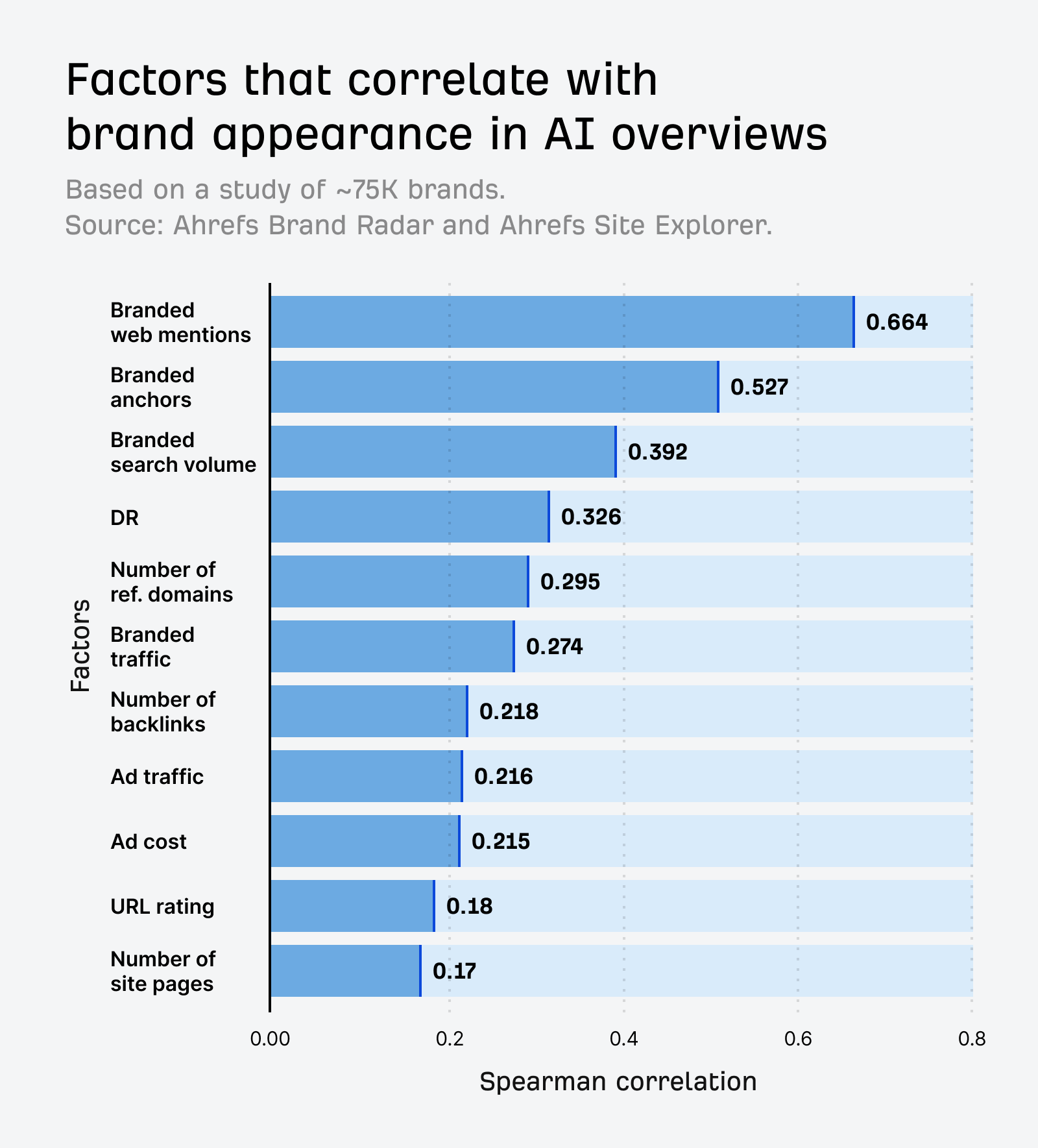
- Entity Authority: Citations are heavily influenced by whether your brand is recognized as a trusted entity across third-party platforms and industry publications, not just on your own domain.
- Semantic Completeness: AI systems favor content that provides a comprehensive, well-structured answer that can be cleanly extracted to satisfy the full intent of a search.
Ultimately, relying on a single #1 ranking is a fragile strategy in an AI-driven landscape where visibility is increasingly distributed across multiple high-authority sources. For WooCommerce merchants, the priority must shift toward building “topical authority” and ensuring product information is formatted for both human conversion and machine readability.
Why is AI Overview visibility critical for WooCommerce revenue growth?
For high-growth WooCommerce brands, visibility in AI Overviews (AIOs) is no longer a luxury but a fundamental necessity for protecting market share. As AIOs occupy the primary real estate at the top of the Search Engine Results Page (SERP), they act as a high-leverage funnel that synthesizes information for users. While research shows a modest Spearman correlation of 0.347 between traditional top-10 rankings and AIO citations, the business reality is that AIOs capture the majority of immediate user attention and can lead to significant drops in traditional organic click-through rates.
- High-Intent Conversion: Users who click through from an AIO citation are often further down the conversion funnel, exhibiting higher engagement and conversion potential than traditional search traffic.
- Brand Authority and Trust: Being cited as a primary source by Google’s AI builds “Mental Availability,” positioning your WooCommerce store as a trusted authority even in zero-click scenarios.
- Smarter Product Positioning: Proper optimization ensures your products are accurately interpreted and recommended by LLMs rather than just being indexed, which is critical as consumer behavior shifts toward conversational research.
Failing to secure these citations means your top organic rankings may be pushed so far down the SERP that they become invisible to mobile users and high-intent shoppers. To drive sustainable revenue growth, WooCommerce merchants must pivot from simply fighting for the top spot to competing for a place within the AI-generated answer, ensuring their brand remains at the center of the modern discovery process.
How to optimize WooCommerce product pages for AI Search citations?
Optimizing WooCommerce product pages for AI Search citations requires a shift from traditional keyword stuffing toward technical clarity and semantic depth. Since nearly half of AI Overview citations come from pages outside the top 10 search results, high-growth brands must prioritize machine-readability and structured formatting to overcome the limitations of traditional ranking signals. By creating “citable” passages that directly resolve complex user queries, you position your store as a primary source for the retrieval-augmented generation (RAG) models that power these AI summaries.
- Structured Data and Schema: Implement comprehensive Product and FAQ schema to help AI systems identify entity clarity, prices, and availability without ambiguity.
- Answer-First Copywriting: Structure product descriptions so they answer specific consumer questions immediately after an H2 or H3 heading, reducing the interpretive work required for the AI to extract your content.
- Semantic Topic Footprints: Use related terms and comprehensive technical specifications to build a thorough topic footprint, signaling to algorithms that your content provides a definitive answer.
To maintain a competitive edge, WooCommerce merchants must treat AI crawlers as their most critical audience by ensuring that every product page delivers unique, non-commodity value that satisfies both user intent and algorithmic retrieval logic. While traditional SEO provides the foundation, winning citations depends on your ability to provide structured, authoritative data that AI models can verify and synthesize with confidence.
How can eCommerce brands measure organic traffic loss from AI Overviews?
For WooCommerce brands, measuring the impact of AI Overviews requires a shift from tracking simple traffic totals to analyzing the health of specific high-intent search queries. With research indicating that nearly one-third of organic keywords now trigger these generative summaries, the primary challenge is identifying where your brand is being displaced by an AIO versus where it is being cited as a primary source. Because organic click-through rates can plummet by up to 70% when an AIO is present without a citation, technical precision in your attribution model is essential to protect your revenue expansion.
To effectively quantify organic traffic loss and assess your brand’s AI reach, WooCommerce store owners should implement the following measurement framework:
- Segmentation by Search Intent: Separate your branded queries from non-branded ones, as non-branded traffic is significantly more vulnerable to AIO disruption and typically experiences a larger decline in click-through rates.
- AIO Presence vs. Source Tracking: Use SEO tools to monitor which of your ranking keywords trigger an AI Overview and cross-reference this with your Search Console data to see if being featured as an AIO source provides a necessary incremental boost to your CTR.
- Attribution Beyond the Click: Shift your focus toward engagement metrics within your ecosystem—such as conversion rates and lead quality—rather than just sessions, as AI Overviews often resolve user intent directly on the SERP, making traditional traffic an incomplete metric for success.
Ultimately, a successful measurement strategy recognizes that traditional search traffic is predicted to decline as users increasingly embrace generative AI for product recommendations. By monitoring your brand’s presence in these AI-driven results and shifting your KPIs toward outcomes like Customer Lifetime Value (LTV) and brand sentiment, you can navigate the structural shifts in the search landscape without compromising your store’s long-term profitability.
Ready to take your e-commerce to the next level?
While establishing a correlation between high organic rankings and AI Overview citations is a technical milestone, the business reality for high-growth WooCommerce brands is that visibility without a conversion-centric strategy is a silent drain on your bottom line. If your organic acquisition feels like it is stalling despite maintaining top positions, or if you suspect that zero-click AI summaries are eroding your market share and customer lifetime value, you are facing a structural displacement that traditional SEO metrics cannot solve. Relying on legacy ranking signals in a generative search environment is no longer enough to drive the revenue expansion necessary for sustained DTC growth.
To navigate this transition from traditional search to an AI-driven ecosystem, you need a strategic partner that synchronizes your technical infrastructure with long-term profitability. We act as an extension of your in-house team, building data-driven systems where advanced tracking, CRM automation, and performance marketing operate in concert to maximize ROAS and LTV. Our process leverages rigorous, conversion-focused audits to eliminate guesswork and identify the exact technical bottlenecks preventing your brand from becoming a preferred AI source. If you are ready to move beyond vanity metrics and build a scalable system that captures high-intent traffic in the age of AI, book a free consultation today.



Comments