


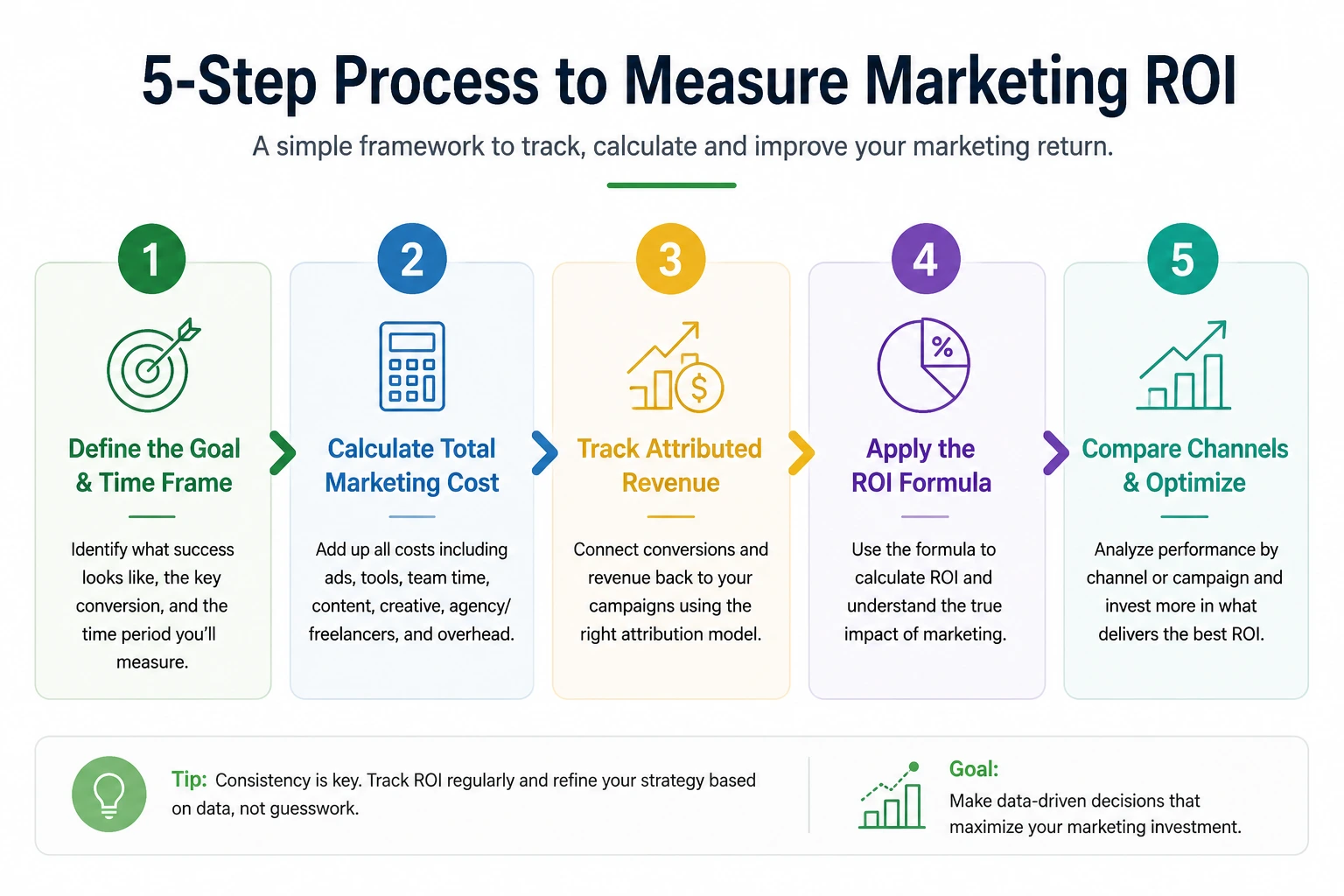
Most ecommerce brands run paid social, paid search, email, and SMS simultaneously — and then try to evaluate each channel’s ROI using platform-reported numbers that were never designed to talk to each other. The result is a familiar problem: every channel looks profitable in its own dashboard, but the combined marketing budget doesn’t add up to the revenue growth it should be producing. In this article, we’ll walk through how to actually measure marketing ROI across multiple channels, the attribution models that make cross-channel comparison possible, and why blended metrics matter more than any single platform’s self-reported performance.
What Does It Actually Mean to Measure Marketing ROI Across Channels?
Measuring marketing ROI across channels means evaluating the return generated by every marketing touchpoint — paid, owned, and earned — against total marketing spend, rather than judging each channel in isolation using its own reporting.
The core challenge is that channels don’t operate independently in a customer’s actual journey:
- A customer might discover a brand through a Meta ad, return later via organic search, and ultimately convert after an email flow — with each platform’s own analytics claiming partial or full credit for that conversion.
- Platform-reported ROAS (Meta’s or Google’s own numbers) reflects that platform’s self-interested attribution model, which tends to overstate its own contribution relative to other channels.
- True cross-channel ROI requires looking at total revenue relative to total marketing spend across every channel combined, not summing up individually reported numbers that overlap and double-count the same conversions.
The mistake most brands make is adding up ROAS figures from each platform and treating the sum as a coherent picture of overall marketing performance. In reality, if Meta claims credit for a conversion and Google Ads claims credit for the same conversion through a different attribution window, the platforms’ combined reported revenue can exceed the store’s actual total revenue — a mathematically impossible outcome that nonetheless shows up constantly in blended platform reporting. Understanding this distortion is the starting point for measuring ROI honestly across a multi-channel marketing mix.
Why Does Platform-Reported ROAS Often Overstate True Performance?
Platform-reported ROAS is calculated using each platform’s own attribution model and tracking data, both of which are structurally biased toward crediting that specific platform — which is why relying on it alone for cross-channel decisions is risky. The mechanisms behind this overstatement include:
- Attribution window generosity: many platforms default to attribution windows (e.g., 7-day click, 1-day view) that credit a conversion to that platform even when the customer’s actual decision was influenced primarily by another channel.
- Overlapping conversion claims: a single purchase can be independently claimed by Meta, Google, and an email platform simultaneously, since each measures its own influence without visibility into the others.
- Declining tracking accuracy: iOS privacy changes and cookie restrictions mean platforms increasingly rely on modeled or estimated conversions rather than directly observed ones, and these models tend to skew favorably toward the platform reporting them.
- View-through attribution: crediting a conversion simply because a user saw an ad, without clicking, inflates a platform’s apparent contribution without strong evidence of causation.
The practical consequence is that a brand can look at three “profitable” channels individually and still be losing money overall, because the reported revenue across platforms overlaps significantly with actual total store revenue. This is exactly why cross-channel ROI measurement requires stepping back from individual platform dashboards and looking at blended, total-business numbers instead.
How Do You Choose the Right Attribution Model for Multi-Channel Measurement?
Attribution models determine how credit for a conversion is distributed across the touchpoints in a customer’s journey, and choosing the wrong model for your business can systematically misrepresent which channels are actually driving revenue. The main attribution models worth understanding:
- Last-click attribution: gives 100% credit to the final touchpoint before conversion — simple, but ignores every channel that contributed earlier in the journey (often undervaluing awareness-stage channels like social or content).
- First-click attribution: credits the initial touchpoint that introduced the customer — useful for understanding top-of-funnel discovery, but ignores what actually closed the sale.
- Linear attribution: spreads credit evenly across every touchpoint in the journey — a reasonable default when you lack strong evidence for weighting any particular stage more heavily.
- Data-driven attribution: uses statistical modeling based on actual conversion patterns to assign credit proportionally — more accurate than rule-based models, but requires sufficient data volume to be reliable.
- MER (Marketing Efficiency Ratio): sidesteps individual attribution entirely by measuring total revenue against total marketing spend, which is particularly useful as a sanity check against platform-level attribution distortion.
No single model is universally correct — the right choice depends on your sales cycle length, the number of channels involved, and how much data volume you have to support a statistical model. Many brands benefit from using a data-driven or linear model for internal analysis while tracking MER as the top-line sanity check that keeps individual channel attribution honest.
When Should You Rely on Blended Metrics Instead of Channel-Level Data?
Channel-level data is essential for tactical, in-platform optimization, but blended metrics become necessary whenever a decision affects overall budget allocation or business-level strategy, since channel-level numbers are structurally prone to overstatement. Situations where blended metrics should take priority:
- Total marketing budget decisions: when deciding how much to spend overall, MER and blended CAC give a far more honest picture than summing individually reported channel ROAS.
- Evaluating whether marketing is profitable at all: this question can only be answered at the blended, whole-business level — no single channel’s reporting can answer it in isolation.
- Comparing performance across time periods: blended metrics are more stable and less vulnerable to attribution model changes or platform algorithm shifts than channel-specific numbers.
- Board or investor reporting: stakeholders need an honest, business-level view of marketing efficiency, not a collection of platform-reported numbers that mathematically can’t all be simultaneously true.
Channel-level data still matters for day-to-day optimization — deciding which ad creative to scale, which keyword to bid on — but conflating that tactical data with strategic, budget-level decisions is one of the most common ways brands misallocate spend, scaling a channel that looks efficient in isolation while blended profitability quietly stagnates.
How Can Marketing Automation and Proper Tracking Improve Cross-Channel ROI Measurement?
Accurate cross-channel ROI measurement depends fundamentally on the quality of the tracking infrastructure feeding it — no attribution model, however sophisticated, can compensate for incomplete or poorly structured underlying data.
The infrastructure elements that meaningfully improve measurement accuracy:
- Server-side tracking (such as server-side Conversions API integrations), which reduces the data loss caused by ad blockers, browser restrictions, and client-side tracking failures.
- First-party data collection, connecting customer identity across channels so a single customer journey can be reconstructed rather than fragmented across disconnected platform-level sessions.
- Consent-compliant data infrastructure, ensuring tracking captures what it legally can without gaps caused by inconsistent consent handling across channels.
- Centralized reporting that pulls WooCommerce order data, ad platform spend, and email/SMS performance into one place, so ROI can be calculated against actual revenue rather than platform-reported estimates.
- Marketing automation platforms integrated with CRM data, which allow email and SMS-driven revenue to be measured with the same rigor as paid channels, rather than treated as a separate, loosely tracked category.
The brands that measure cross-channel ROI most accurately are the ones treating tracking infrastructure as a strategic investment, not an afterthought bolted onto existing ad accounts — because every gap in that infrastructure directly translates into a blind spot in understanding which channels are actually driving profitable growth.
Ready to take your e-commerce to the next level?
If your platform dashboards all report healthy ROAS but your overall marketing budget doesn’t feel like it’s translating into proportional growth, the disconnect usually isn’t a channel problem — it’s a measurement problem. Relying on each platform’s self-reported numbers to make budget decisions is how brands end up scaling channels that look efficient individually while blended profitability quietly stalls.
This is exactly the kind of gap we help DTC and ecommerce brands close. As an extension of your in-house team, we build data-driven systems where advanced tracking, attribution, and paid media work together across Google Ads, Meta Ads, and lifecycle channels — so ROI decisions are based on what’s actually happening, not overlapping platform claims. If you want an honest, blended read on which channels are truly driving profitable growth, book a free marketing automation audit and get a data-driven, conversion-focused view of your real marketing ROI.



Comments