






Many brands operate under the comforting illusion that a single, static cookie banner is sufficient for global compliance, believing that as long as a notice is present, their legal obligations are met. But what if this reliance on a one-size-fits-all approach is actually acting as a silent ceiling on your revenue expansion? For high-growth eCommerce businesses, the hidden cost of inaction lies in the loss of data-driven insights and user trust when restrictive banners are shown to audiences in regions that actually allow for more flexible consent, effectively leaving massive amounts of money on the table by prematurely killing the tracking required for high-converting Email and SMS marketing flows.
The hard reality is that different jurisdictions demand different rules, and failing to adapt to local requirements like GDPR and CCPA through precision-engineered geo-targeting is a recipe for stagnant ROI and legal liability. Transitioning to dynamic consent tools is not merely a technical preference; it is a strategic necessity that ensures your website respects user privacy without disrupting the engagement needed to maximize Customer Lifetime Value (LTV). This guide explores how implementing geo-targeted cookie banners provides the critical infrastructure needed to protect your brand while maintaining the flow of behavioral data essential for fueling automated workflow efficiency and scalable growth.
What is geo-targeting for cookie banners?
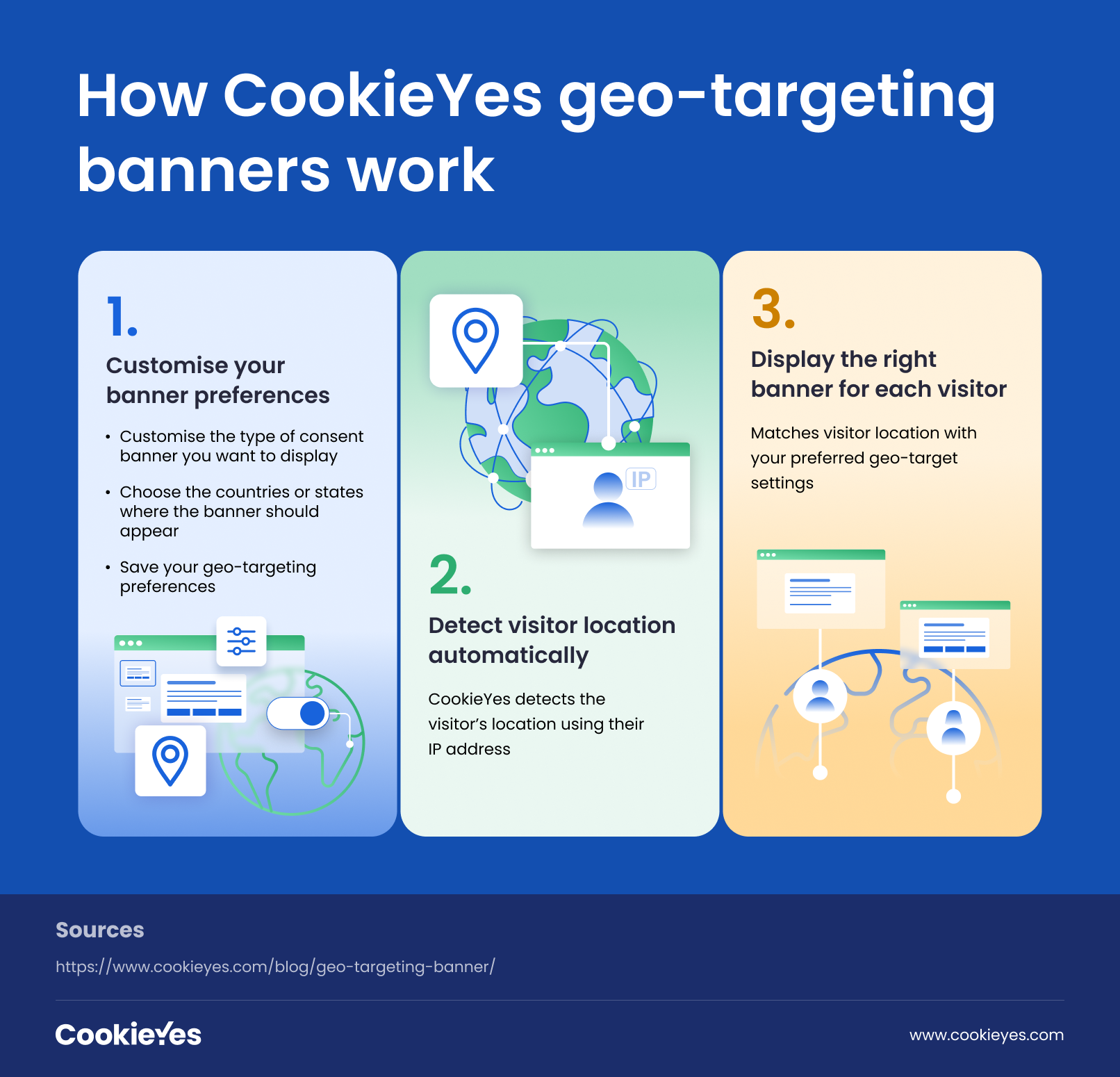
Geo-targeting for cookie banners is a sophisticated compliance technology that uses IP address detection to identify a visitor’s geographic location in real time. For WooCommerce store owners operating globally, this tool is essential because it replaces the “one-size-fits-all” banner with a dynamic interface that automatically serves the specific legal requirements of the user’s jurisdiction. Instead of showing a strict EU-style opt-in banner to a visitor in a region with more relaxed privacy laws, geo-targeting ensures your site remains compliant without unnecessarily hindering the user experience for everyone.
- IP Intelligence: The system identifies the visitor’s country or state by checking their IP address against a global geolocation database.
- Dynamic Rule Application: Once the location is confirmed, the banner switches its behavior—for example, displaying a “Reject All” button for GDPR regions while showing a simple “Notice at Collection” for CCPA regions.
- UI/UX Optimization: The banner can be configured to change languages or layout based on the region, ensuring that the privacy notice is both legally valid and accessible to the local audience.
Implementing geo-targeting is a strategic move for high-growth eCommerce brands that need to babidding global expansion with strict data sovereignty. By isolating compliance requirements to specific regions, you protect your conversion rates in less regulated markets while maintaining a bulletproof legal posture in regions like the European Union or California. This granular control transforms privacy compliance from a technical hurdle into a seamless part of your global customer journey.
Why is geo-targeting essential for WooCommerce compliance?
For high-growth WooCommerce stores, the challenge of global compliance lies in the fragmentation of data privacy laws. While the GDPR in the European Union mandates a strict opt-in (prior consent) model, other regions like California under the CCPA/CPRA follow an opt-out framework. Relying on a single, static banner across all regions creates a strategic bottleneck: you either risk non-compliance in strict jurisdictions or unnecessarily degrade the user experience and conversion rates in more relaxed ones by over-regulating your interface.
- Legal Precision: Geo-targeting ensures that your store automatically triggers the specific legal requirements of the visitor’s jurisdiction, such as displaying a “Do Not Sell My Personal Information” link for Californians while providing granular category toggles for EU residents.
- Conversion Optimization: By only displaying intrusive consent banners where legally required, you reduce “banner fatigue” and friction for global audiences, maintaining higher engagement levels for users in regions with fewer restrictions.
- Risk Mitigation: Automated regional detection minimizes the risk of human error in manual configurations, protecting your brand from the heavy financial penalties associated with mismanaging user data in highly regulated markets.
Transitioning to a geo-targeted infrastructure is a technical necessity for any WooCommerce brand scaling internationally. It allows you to maintain a professional, localized user experience that builds trust without sacrificing the data-driven insights necessary for growth. By aligning your consent management with the specific location of your peak customer intent, you ensure that your compliance strategy acts as a facilitator for revenue expansion rather than a structural barrier.
How does geo-targeting make a website GDPR and CCPA ready?
Geo-targeting transforms a static WooCommerce storefront into a dynamic, privacy-compliant engine by leveraging GeoIP detection to identify a visitor’s jurisdiction in real-time. This technological layer allows your site to bypass the “one-size-fits-all” limitation, where a single banner might be too restrictive for North American users or legally insufficient for European residents. By programmatically adjusting the consent mechanism based on the user’s IP address, brands can maintain high conversion rates in opt-out regions while ensuring total legal air-cover in strict opt-in territories.
- GDPR Precision (EU/UK): Automatically triggers a “Prior Consent” model for EEA and UK visitors. This ensures that no non-essential cookies are dropped before a clear, affirmative action is taken, meeting the strict opt-in requirements of the GDPR.
- CCPA/CPRA Flexibility (USA): Detects California-based traffic and serves a notice-at-collection banner that includes a “Do Not Sell or Share My Personal Information” link. This satisfies the opt-out framework required by US state laws without hindering the user experience for international visitors.
- Dynamic Policy Routing: Redirects users to region-specific privacy policy versions or dynamically updates the “Cookie Settings” interface to reflect the specific legal rights (such as the Right to Erasure or Right to Opt-Out) applicable to that visitor’s location.
Implementing this logic is a critical move for high-growth brands that cannot afford the revenue drag of unoptimized consent flows. By automating regional compliance, you eliminate the manual burden of tracking shifting global regulations and protect your brand from the significant financial and reputational risks associated with non-compliant data processing. This data-driven approach to privacy ensures that your store remains agile, scaling seamlessly across borders while respecting the unique digital rights of every customer.
When should I use a geo-targeted cookie banner for my store?
Deciding when to deploy a geo-targeted cookie banner is a strategic choice that babiddings regulatory risk with conversion rate optimization. For WooCommerce store owners, the primary trigger is cross-border trade; if your storefront processes transactions or even simple traffic from multiple jurisdictions like the EU and the United States, a one-size-fits-all banner is likely costing you data or revenue. By implementing geo-targeting, you move away from the “lowest common denominator” approach—where you apply the strictest global laws to everyone—and instead serve a tailored experience that respects local legal nuances without adding unnecessary friction for users in less regulated regions.
- Global Traffic Footprint: If your analytics show significant sessions from regions with distinct laws, such as GDPR in Europe or CCPA/CPRA in California, geo-targeting ensures you are showing the correct opt-in or opt-out mechanism required by those specific authorities.
- Conversion Rate Optimization: In regions with more relaxed privacy requirements, you should avoid the intrusive “hard block” banners required by GDPR. Geo-targeting allows you to show a simple notice to these users, keeping your marketing tags active immediately and reducing bounce rates.
- Scaling Marketing Attribution: High-growth brands relying on Meta or Google Ads need accurate data. Geo-targeting allows you to maximize data collection in regions where prior consent isn’t diretrizry, ensuring your ad spend remains optimized while maintaining strict compliance where it is required.
Ultimately, the transition to geo-targeting is necessary the moment your manual compliance efforts become a bottleneck for global expansion. As new privacy laws emerge in the Middle East and Asia, a dynamic targeting system future-proofs your WooCommerce store, allowing you to add or adjust regional banners programmatically. This technical agility ensures that your brand remains a trusted player in every market you enter, protecting you from hefty non-compliance fines while preserving the integrity of your customer journey.
How to automate regional consent to improve eCommerce conversion rates?
Automating regional consent through geo-targeting is a critical performance lever for WooCommerce stores operating in multiple jurisdictions. By programmatically detecting a visitor’s IP address, your site can bypass restrictive “opt-in” banners for users in regions like the United States where “opt-out” is the standard, thereby reducing immediate friction in the conversion funnel. This ensures that high-intent traffic from less regulated markets isn’t subjected to invasive UI elements that are legally unnecessary, preserving the user experience while maintaining strict compliance for GDPR-sensitive regions.
- Dynamic Banner Rendering: Automatically switch between explicit consent (GDPR) and implicit notice (CCPA) based on the user’s geolocation to maximize initial engagement.
- Frictionless UX for Low-Regulation Zones: Suppress or minimize consent notices for visitors from regions without strict privacy mandates, preventing unnecessary bounces.
- Granular Cookie Control: Use automated tools to block specific scripts only when required by local law, ensuring marketing pixels and analytics continue to track accurately where permitted.
Implementing an automated consent strategy effectively removes the “silent ceiling” on your conversion rates caused by generic, site-wide privacy settings. By tailoring the legal requirements to the specific user’s location, you transform a compliance hurdle into a competitive advantage that respects data privacy without sacrificing the technical data needed for revenue expansion.
Ready to take your e-commerce to the next level?
While understanding the technical necessity of geo-targeted cookie banners is a critical first step, the business reality for high-growth WooCommerce brands is that compliance without a conversion strategy is a recipe for abandoned sessions and lost data. If your privacy efforts feel like they are stalling revenue or if you suspect that rigid consent walls are unnecessarily eroding your marketing attribution, you are facing a structural barrier to scaling. Relying on a one-size-fits-all banner is no longer just a legal risk; it is a direct compromise of your user experience and your ability to collect the high-quality data required to optimize performance in a global market.
To move beyond basic compliance and build a privacy-first growth engine, you need a partner that synchronizes your consent management with your broader business objectives. We act as a strategic extension of your team, helping DTC brands maximize Profit, Retention, and LTV through data-driven systems where tracking, CRM, and automation operate in perfect, privacy-compliant concert. Our process begins with rigorous, conversion-focused audits to eliminate guesswork and identify the exact bottlenecks in your data collection and customer journey. If you are ready to transition from static banners to a dynamic, geo-targeted system that maximizes ROAS while respecting user choice, book a free marketing automation audit today.