

The aggressive integration of AI Overviews into Google Search is fundamentally altering the economics of organic discovery, moving the goalposts for every brand that relies on informational content to fill the top of their funnel. While official narratives often emphasize increased engagement, a cold analysis of search behavior reveals a more disruptive reality for eCommerce leaders: the convenience of synthesized answers is actively siphoning away the clicks that traditionally sustained steady site traffic. This shift isn’t just a technical update; it is a structural change in how potential customers interact with your brand before they ever reach your store.
Ignoring this downward trend in click-through rates is a high-stakes gamble that risks leaving your customer acquisition strategy anchored to a declining medium. For brands positioned to scale in 2026, the challenge lies in navigating this zero-click environment by understanding the data-backed correlation between AI presence and traffic erosion. This analysis dissects the specific impact of AI Overviews on top-ranking visibility, providing the commercial clarity necessary to evolve your digital footprint and capture intent within Google’s new AI-first architecture.
What are Google AI Overviews and how do they work?
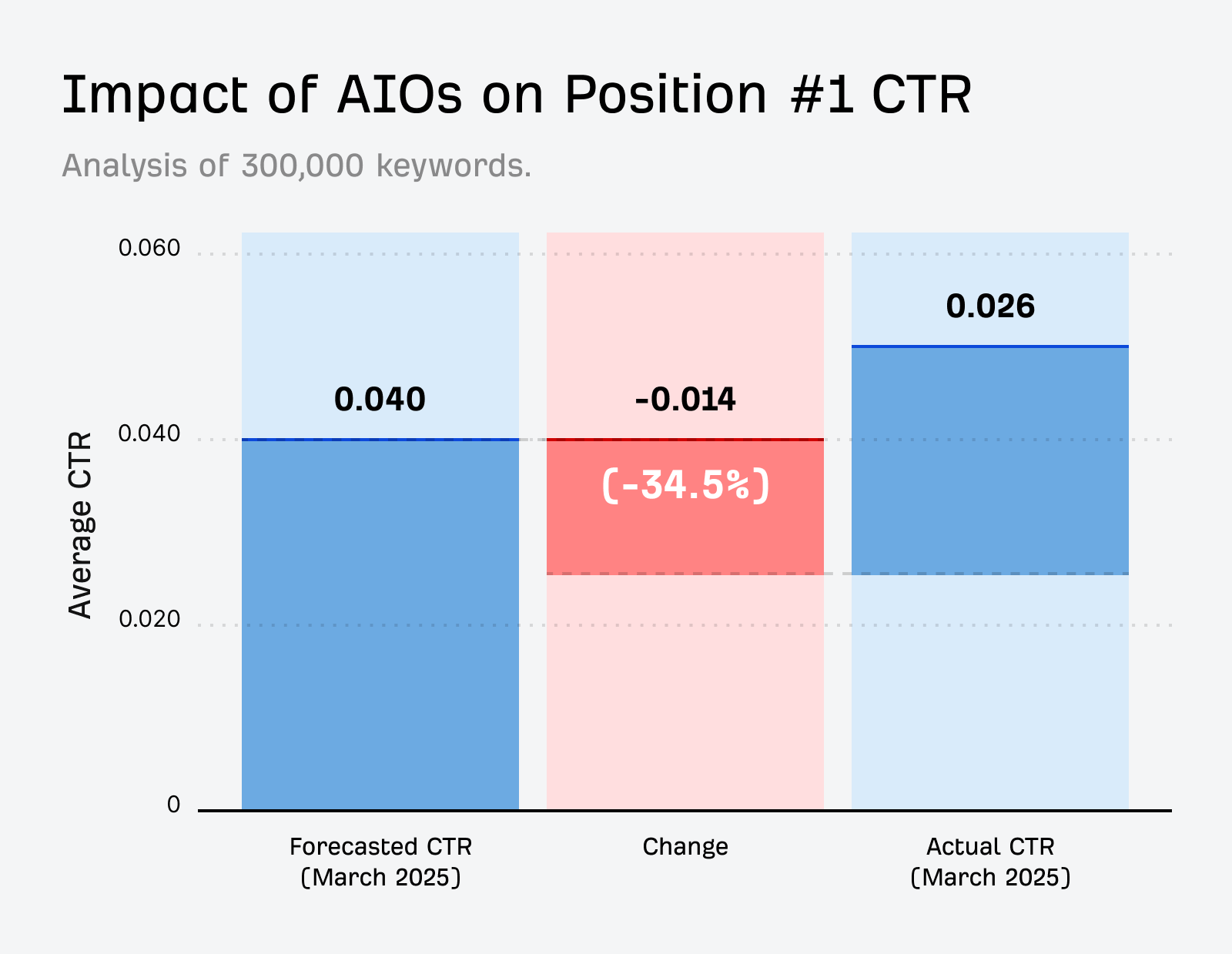
Google AI Overviews (AIO) are AI-generated summaries that synthesize information from multiple web sources to provide direct answers at the top of the Search Engine Results Page (SERP). For WooCommerce store owners, this represents a fundamental shift from the traditional “ten blue links” to a “zero-click” environment where Google aims to resolve user intent without requiring a visit to an external site. While Google suggests these features increase engagement, data-driven research indicates that the presence of an AIO correlates with a 34.5% lower average click-through rate for top-ranking organic pages.
- Grounding: This is the process where the AI model anchors its response to specific, high-authority web sources to ensure factual accuracy and provide citations.
- Retrieval System: AIO uses a separate retrieval mechanism from standard organic rankings, often selecting candidate pages based on relevance and content quality rather than traditional SEO factors alone.
- Citation Mapping: The system attaches links and expandable citations to the generated text, which can actually yield higher click-through rates for the specific pages cited within the overview compared to those listed below it.
Understanding this mechanism is critical for eCommerce brands because the AI selects and summarizes content selectively, currently appearing in less than 10% of total queries. To remain visible, stores must move beyond simple keyword targeting and focus on becoming a “grounding source” by providing authoritative, structured, and semantically rich content that the AI can easily digest and cite. Failure to adapt to this shift in the information battleground means risking a significant portion of organic traffic to these automated summaries.

Why do AI Overviews reduce organic CTR for WooCommerce stores?
For high-growth WooCommerce stores, the introduction of Google AI Overviews has created a significant “zero-click” barrier that intercepts users before they ever reach your product or category pages. Research indicates that the presence of an AI Overview correlates with a 34.5% lower average click-through rate (CTR) for top-ranking pages. This decline is primarily driven by the fact that these AI-generated summaries satisfy informational intent directly on the search engine results page (SERP), rendering a traditional click unnecessary for many users.
- SERP Displacement: AI Overviews dominate the “above the fold” real estate, pushing organic WooCommerce rankings further down the page and reducing their immediate visibility to consumers.
- Direct Intent Satisfaction: By synthesizing answers from multiple sources, AI Overviews provide immediate, contextual answers that often resolve simple product-related or informational queries without requiring a site visit.
- Increased Zero-Click Searches: The convenience of synthesized answers at the top of the SERP is fundamentally shifting user behavior toward platform-driven consumption rather than traditional website exploration.
While the overall organic CTR is under pressure, the business reality is that visibility now hinges on being cited within the AI Overview itself. Analysis shows that content and links placed within these snapshots can actually achieve higher click-through rates than those sitting outside of them. For WooCommerce brands, this technical shift necessitates a move from basic keyword ranking toward a strategy of “Search Visibility Optimization,” where the goal is to secure authoritative citations that capture qualified traffic despite the broader decline in generic search clicks.
How to optimize eCommerce content for AI Overview citations?
To optimize your WooCommerce store for AI Overview citations, you must transition from traditional keyword density to a strategy centered on information retrieval and structural clarity. Since AI Overviews synthesize data from multiple high-ranking sources, being cited is the only way to recover the 34.5% CTR loss typically seen in top organic positions. Google prioritizes content that is factually dense and formatted for easy extraction by large language models, making technical precision as important as topical authority.
- Answer-First Architecture: Place direct, concise answers to high-intent queries at the beginning of your product guides or category descriptions to serve as ideal snippets for AI synthesis.
- Structured Data Implementation: Use advanced Schema markup, specifically FAQ, HowTo, and Product snippets, to provide a machine-readable layer that helps AI engines identify and attribute your unique data points.
- Proprietary Data Integration: Incorporate original survey results, expert reviews, or firsthand testing data that cannot be found in common training sets, forcing the AI to retrieve and cite your specific page for that unique information.
By implementing these technical signals, you ensure that even when a user does not click through to your site, your brand gains visibility as a primary authority. Research indicates that being cited in an AI Overview can drive a 34% uplift in branded search volume, effectively turning a potential traffic loss into a powerful long-term brand awareness play.

How to use email automation to recover traffic lost to AI search?
For WooCommerce store owners, the documented 34.5% decline in organic click-through rates caused by AI Overviews represents a structural shift from discovery-based search to zero-click fulfillment. To hedge against this loss of top-of-funnel visibility, brands must pivot from a total reliance on Google to a strategy of owned-audience retention. Email automation serves as the primary recovery mechanism, transforming one-time visitors—who are becoming increasingly rare—into a predictable, high-LTV database that bypasses the AI gatekeeper entirely.
- Behavioral Browse Abandonment: Implement automated triggers that capture intent at the session level; when a cookied user views a product but doesn’t add to cart, trigger a personalized follow-up to recover the visit before the user returns to an AI-driven search interface.
- Zero-Party Data Progressive Profiling: Use automated workflows to collect specific customer preferences and milestones, allowing you to send hyper-relevant, event-driven communications that maintain brand authority and recurring traffic independent of search rankings.
- Lifecycle Re-engagement Loops: Establish automated sequences based on product usage or purchase cycles to bring customers back to your site at the exact moment of predicted need, effectively insulating your revenue from the volatility of AI-reshaped SERPs.
The transition to an automated email infrastructure is no longer a marketing luxury but a technical necessity to combat declining organic reach. By leveraging behavioral triggers—such as abandoned carts or specific category views—WooCommerce merchants can create a closed-loop system where traffic is “recycled” through automated engagement rather than being lost to the zero-click abyss. This shift ensures that even as Google’s AI summaries provide answers on the search page, your store maintains a direct, unmediated connection to your customers’ inboxes.
How to scale WooCommerce revenue despite declining organic search clicks?
Scaling WooCommerce revenue in an era where AI Overviews reduce top-tier organic clickthrough rates by 34.5% requires shifting your strategy from broad traffic acquisition to high-intent conversion and retention. While informational queries are seeing a steep 61% decline in CTR as Google resolves user needs directly on the search results page, research indicates that the traffic which does survive is often higher-intent, as these users are seeking deeper information beyond the AI summary. To maintain growth, WooCommerce brands must pivot their focus toward query types that AI is less likely to dominate and maximize the value of every remaining visitor.
To build a resilient revenue engine that thrives despite declining search clicks, prioritize the following strategic adjustments:
- Commercial Intent Prioritization: Reallocate your content budget toward transactional and comparison queries, as AI Overviews appear more aggressively on informational searches than on high-value commercial ones.
- Lifecycle Marketing and Retention: Invest in advanced email automation and loyalty programs to increase Customer Lifetime Value (LTV), offsetting the loss of new top-of-funnel organic traffic.
- LLM and Answer Engine Optimization: Improve content structure with clear headings and precise language to increase the likelihood of being cited within AI Overviews, which can yield higher clickthrough rates than traditional listings.
- Revenue-Per-Session Metrics: Shift your internal KPIs from total organic traffic to revenue per organic session; surviving clicks often convert 23% better, turning a volume loss into a quality filter.
Ultimately, brand authority has become a critical piece of search infrastructure. By strengthening your presence in industry-specific directories and earning mentions in credible publications, you ensure that AI tools endorse your store as a trusted entity, securing your visibility even as traditional organic rankings become more volatile. Adapting to this new reality is not a retreat, but a technical necessity for capturing market share in an AI-first search landscape.
Ready to take your e-commerce to the next level?
While the data confirms that AI Overviews are creating a measurable decline in organic clickthrough rates, the broader business reality for WooCommerce brands is that relying on top-of-funnel traffic alone is a increasingly fragile strategy for revenue expansion. If your organic growth feels like it is hitting a structural ceiling, or if you suspect that the shift toward zero-click searches is quietly eroding your customer acquisition pipeline, you are facing a fundamental transition in search behavior that vanity metrics cannot solve. Navigating this shift requires moving beyond a reliance on broad informational intent and toward a model where every captured click is maximized through precision-engineered retention and conversion frameworks.
To protect your margins in this changing landscape, you need a strategic partner that transforms your technical infrastructure into a high-performance growth engine. We act as an extension of your in-house team, building data-driven eCommerce systems where advanced tracking, CRM automation, and performance marketing operate in perfect concert to maximize Profit, Retention, and LTV. Our process eliminates guesswork through rigorous, conversion-focused audits that identify the exact bottlenecks in your customer journey and unlock hidden revenue opportunities within your existing data. If you are ready to stop chasing declining clicks and start building a resilient system that scales ROAS despite search disruption, book a free consultation today.



Comments